
Summary
Energy gained as supply disruptions persist. Gold surged as weaker bond yields boosted investor appetite. Sentiment was also boosted by a weaker USD.
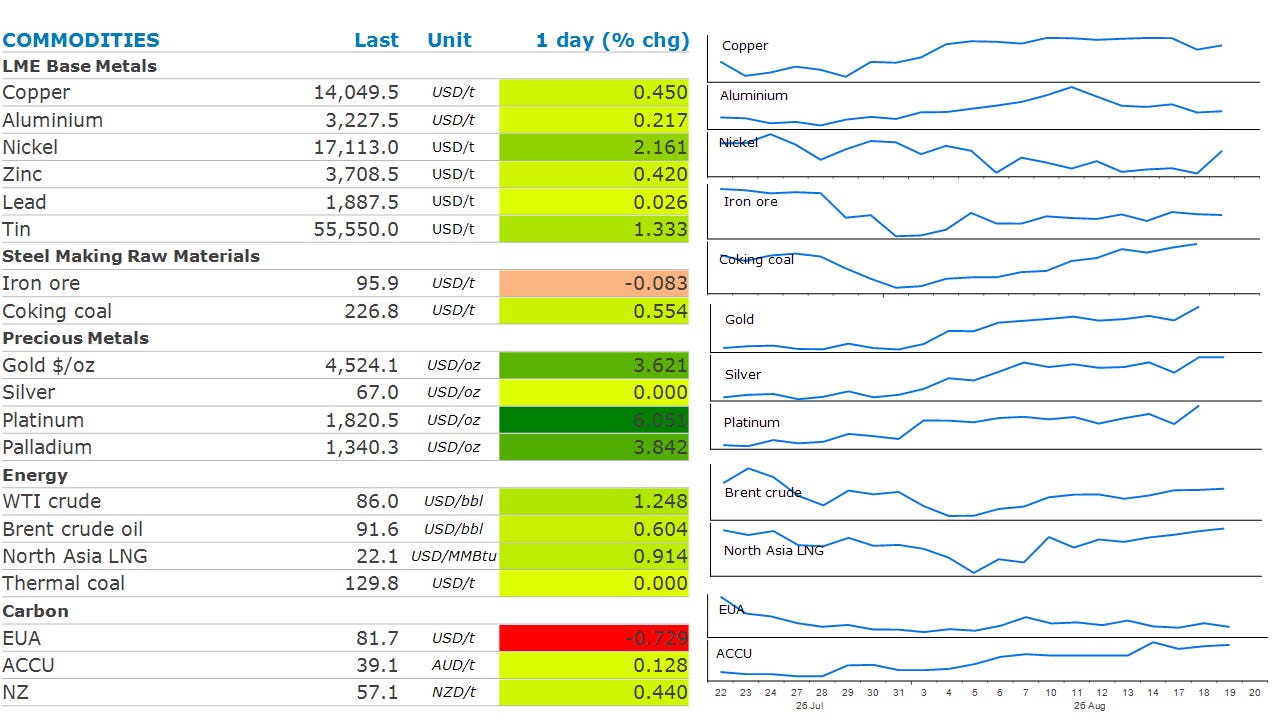
Prices and commentary accurate as of 07:00 Sydney/05:00 Singapore/17:00(-1d) New York/22:00(-1d) London.
Ahead Today
Public holidays: None.
Central bank speakers: ECB Governing Council member Olaf Sleijpen speaking in Paramaribo, Suriname.
Economic data: Australia: Unemployment rate; China: loan prime rates; Denmark: GDP; Hong Kong: CPI, unemployment; Japan: trade, foreign bond buying; Malaysia: trade; Mexico: central bank minutes; Sweden: rate decision; Taiwan: export orders; US: initial jobless claims (NY 08:30 / UK 13:30 / AEDT 22:30), Philadelphia Fed business outlook, Conference Board leading index (NY 10:00 / UK 15:00 / AEDT 00:00 Fri).
Commodities reports: Singapore weekly onshore oil-product stockpiles; Insights Global weekly ARA oil-product inventories; EIA weekly US natural gas inventories (NY 10:30 / UK 15:30 / AEDT 00:30 Fri); China third batch of trade data including country-level energy and commodities trade; LME inventory and warrant data (~NY 04:00 / UK 09:00 / AEDT 18:00); SHFE warrant change data.
Events: Alibaba earnings; Walmart earnings; BMW Championship begins (to 23 Aug).
Market data: WTI September futures expiry.
Listen to today’s 5in5 with ANZ podcast for more on the global economy and markets.
Market Commentary
Crude oil prices continued to push higher as rising tensions in the Middle East threatened to disrupt oil flows even more. The United Arab Emirates said that it was cutting all economic ties with Iran after it accused it of firing ballistic missiles at its territory. This is the first exchange since the earlier stages of the current Middle East conflict. While UAE’s energy infrastructure was not targeted, it closes another potential avenue for diplomatic efforts to end the conflict and reopen the Strait of Hormuz. This latest event has kept risks to shipping in the region at elevated levels. Three supertankers linked to China and originally headed out of the Persian Gulf turned around in the Strait of Hormuz yesterday. The prospect of the conflict persisting has weighed on sentiment. President Trump insisted there are no talks ongoing with Iran to end the conflict.
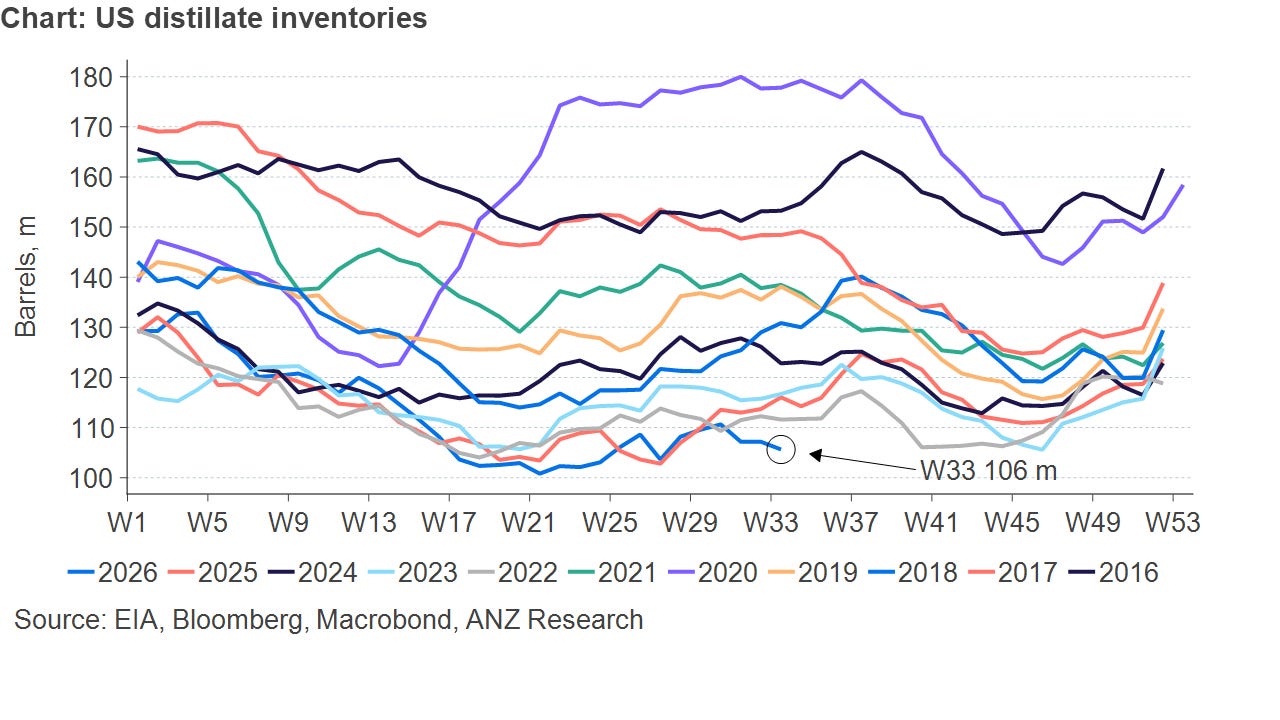
Meanwhile, tightness in the refined fuel markets is worsening. US distillate inventories fell again last week, down 1.5mbbl to their lowest level since the end of July. Nationally, distillate supplies remain at their lowest seasonal levels since 1996, as the winter heating season nears. The tightness has pushed refining margins above USD100/bbl. US refinery runs have subsequently risen to their highest level since 2019. Overall, US crude oil inventories rose last week by 4,405kbbl. This was offset by a drawdown in the US Strategic Petroleum Reserve of 5,268kbbl.
North Asia LNG prices gained as byers continue to search for cargo amid the supply disruptions in the Middle East. Bangladesh is said to be seeking three shipments for August and September delivery. Thailand is looking for shipments for October. China has ramped up imports. Official data show July imports of LNG rose 2.4% y/y to 5.5mt. The July increase follows an 8.3% y/y rise in June.
Gold surged as US government bond yields fell following its surprise liquidity injection. This was triggered by the announcement that the US Treasury was ramping up its buyback of long-dated government debt, a signal that it wants lower borrowing costs. The move would suggest we may ultimately see easier financial conditions, a backdrop which usually supports higher gold prices. Gold was already improving, having briefly touched USD4,000/oz last month before rebounding strongly on the back of renewed investor demand and central bank buying. The improving backdrop has seen gold-backed ETFs receive strong inflows. Holdings rose by more than 257koz on Tuesday, the biggest daily inflow since April, according to Bloomberg data. Other precious metals joined the ride, with silver gaining more than 4%, while platinum rallied nearly 6%.
The base metals sector gained as the bond buyback weakened the USD and boosted investor appetite for commodities. This was despite another day of strong builds in inventories. The current squeeze in the copper market is easing after large inflows of metal into LME warehouses. Inventories on warrant rose by more than 35kt, the most since 2024, according to LME data. That followed an increase of more than 20kt the previous session. Prior to this influx, inventories had fallen by about 75% from a mid-April high. This should relieve pressure that had been building on LME contracts, which underpin most global trade. Nevertheless, concern about US import tariffs on refined metal will hang over the market, which is still waiting for the results of a US investigation into the copper industry that could see levies applied to imports
Chart of the Day
US inventories of distillate fell further last week and now sit around 20mbbls below the 10 year seasonal average. With inventories depleted and supply buffers limited, diesel markets remain highly sensitive to further disruptions. Seasonal refinery maintenance in September and October is set to coincide with stronger agricultural, industrial and heating demand, creating another headwind for supply. While crude markets are gradually adjusting to the disruption in Persian Gulf supply, diesel availability is likely to recover more slowly. As a result, diesel cracks should remain elevated even if outright oil prices retreat.
5in5 with ANZ Podcast
