Commodities Wrap: Rising hopes of a US-Iran peace deal sends oil lower
Friday 22 May, 2026

Summary
The prospect of a deal between the US and Iran sent energy markets lower. Industrial metals fell as concerns about demand persisted. Precious metals were the only sector to end the session higher.
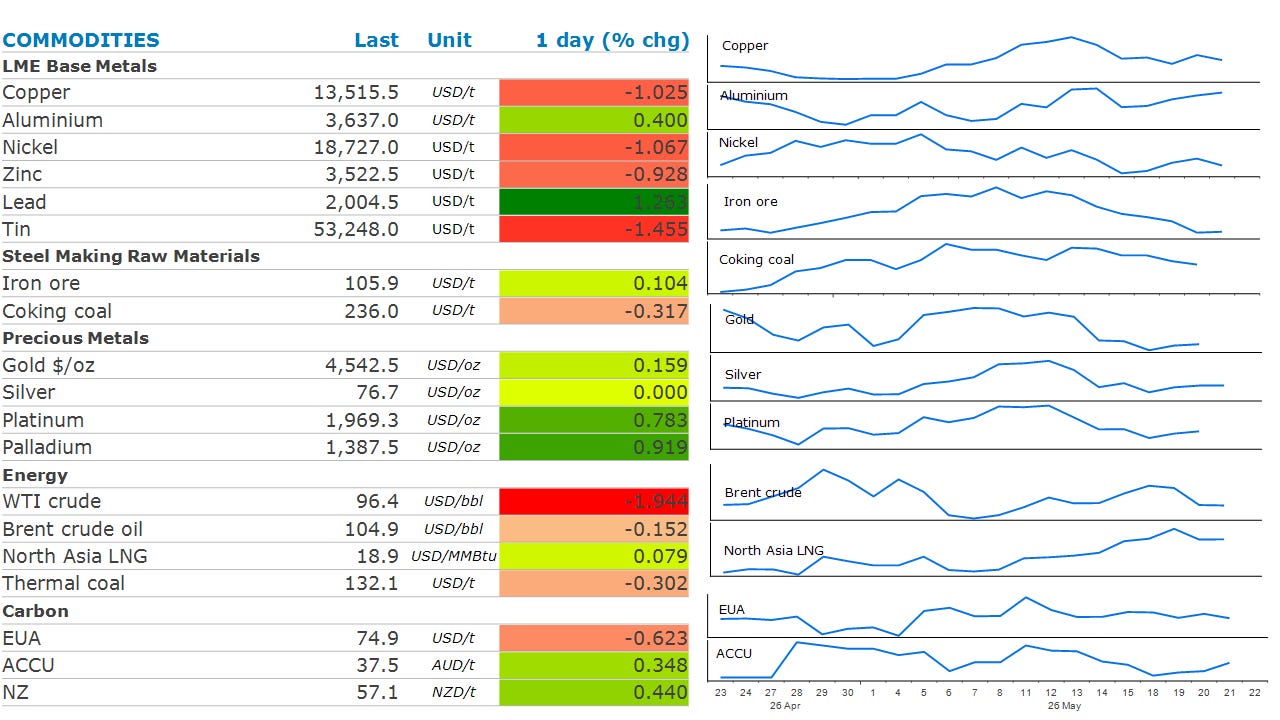
Prices and commentary accurate as of 07:00 Sydney/05:00 Singapore/17:00(-1d) New York/22:00(-1d) London.
Ahead Today
Public holidays: — NA
Central bank speakers: ECB’s Christine Lagarde; ECB’s Boris Vujcic; ECB’s Peter Kazimir; ECB’s Madis Muller; ECB’s Philip Lane; Fed’s Christopher Waller; Riksbank’s Goran Hjelm
Economic data: Canada – retail sales; Germany – IFO business climate; GDP; GfK confidence; Japan – CPI; Macau – visitor arrivals; Malaysia – foreign reserves; Mexico – GDP; bi weekly CPI; New Zealand – retail sales; South Korea – consumer confidence; UK – consumer confidence; retail sales; US – University of Michigan sentiment
Commodities reports: Shanghai exchange weekly inventories (~15:30 local); Baker Hughes rig count (13:00 NY); CFTC commitment of traders (15:30 NY); ICE Europe commitment of traders (18:30 London)
Events: APEC trade ministers meeting (through 23 May); EU Foreign Affairs Council (Trade); NATO foreign ministers informal meeting (final day)
Market data: — NA
Listen to today’s 5in5 with ANZ podcast for more on the global economy and markets.
Market Commentary
Crude oil prices suffered a third consecutive day of losses and speculation is mounting about a peace deal between the US and Iran. Both sides have signalled progress in recent talks. The semi-official Iranian Students News Agency reported that the text submitted by the US has narrowed the gaps to some extent. This comes after US President Donald Trump repeatedly said an agreement is close. Nevertheless, tensions remain high. Oil prices pared some of the losses after Iranian President Masoud Pezeshkian said the country won’t back down in talks. The issues at stake remain the location of Iran’s uranium stockpile and control over the Strait of Hormuz. The latter was brought into focus amid reports that Iran was discussing with Oman how to set up some form of permanent toll system that would formalise Iran’s control over maritime traffic through the key waterway. Iran has also expanded its claimed area of jurisdiction and set out new rules for vessels transiting the strait.
Despite the recent bearish tone in oil markets, traders and investors remain concerned about the long-term impact of the Middle East conflict. A Bloomberg survey showed that a majority of respondents expect oil futures to carry a lasting risk premium for years to come because of the structural shifts triggered by the conflict. Abu Dhabi National Oil Co CEO Sultan Al Jaber said the Middle East oil flows would not fully recover until well into 2027, even if the conflict ended immediately. In the meantime, inventories are helping buffer the supply shock. US government data released earlier this week showed that US crude oil inventories fell by a record 17.8mbbls last week. The International Energy Agency said that the oil inventory release was only about 20% of stocks, and it is ready to act if nations want a further injection
European natural gas futures followed Brent crude lower. Nevertheless, the current summer premium over winter gas prices is making gas stockpiling uneconomical and storage injections have slowed sharply in recent weeks. Adding to market tightness, many major gas facilities are conducting seasonal maintenance, including Europe’s biggest pipeline gas supplier, Norway. North Asian LNG prices managed to push higher as planned labour strikes by LNG workers in Australia threaten to tighten the market even further.
Copper fell as the impasse in US-Iran talks caused some concern over whether the fragile ceasefire in the Middle East can turn into a peace deal. The conflict has dented the outlook for global growth and spurred central banks to consider raising rates, a negative for industrial metals. There has also been a divergence in tone across regions. A more modest tone in US equity markets has quelled any exuberance. In contrast, Asia has been gripped by buoyant optimism. This has been triggered by hopes that the AI-centred investment activity will stoke strong demand for key metals such as copper.
Gold erased earlier losses as speculation of a US-Iran deal triggered a lowering of bets that central banks may need to keep interest rates higher for longer to combat inflation. Minutes from the recent FOMC meeting showed that officials were considering raising rates should higher energy costs keep inflation elevated.
Chart of the Day
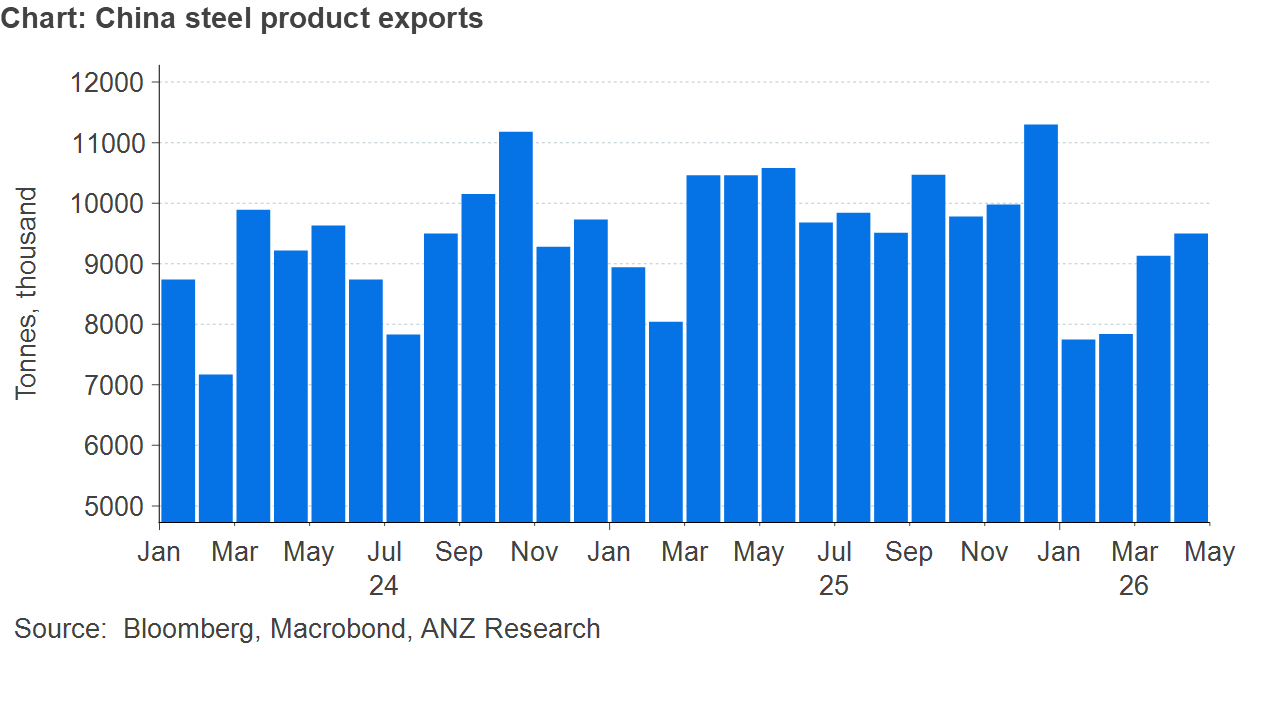
CHIna’s exports of steel has risen sharply over the past couple of months as the world’s biggest producers looks to offset falls in Iran’s output. China’s exports of semi-finished steel rose to 1.34mt in April, just shy of its record high. Total steel product exports have also seen a increase in recent months. Iran was a major exporter of steel billet or slab, that are sent elsewhere for final processing. However, the Middle East conflict has seen its exports severely constrained.
5in5 with ANZ Podcast
