Commodities Wrap: Oil surges higher amid renewed attacks in the Middle East
Thursday 30 July, 2026

Summary
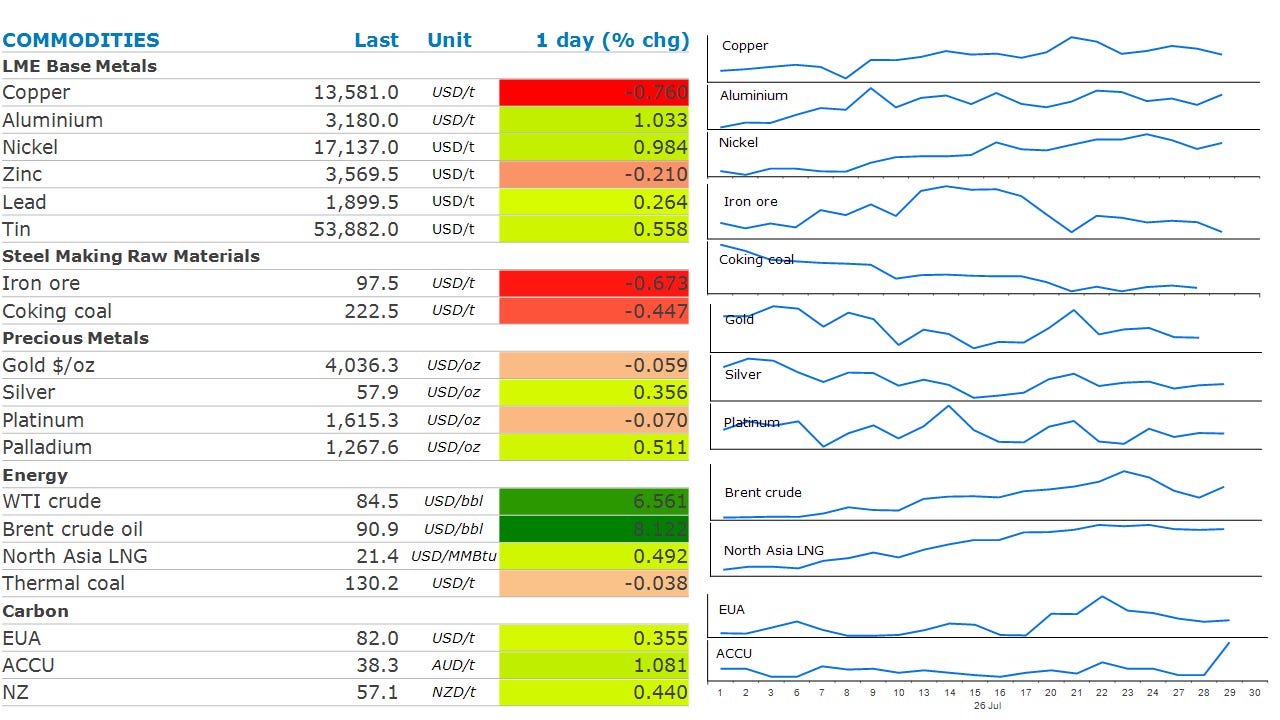
Renewed attacks in the Middle East saw oil and gas prices surge higher. Precious metals gained after the Fed held rates steady. Industrial metals fell on reduced risk appetite.
Prices and commentary accurate as of 07:00 Sydney/05:00 Singapore/17:00(-1d) New York/22:00(-1d) London.
Ahead Today
Public holidays: None
Central bank speakers: Bank of England Governor Andrew Bailey press conference; RBA Assistant Governor Sarah Hunter at Barrenjoey Economics Forum, Sydney
Economic data: Australia: building approvals; Czech Republic: GDP; Eurozone: GDP (11:00am Brussels / 5:00am NY / 7:00pm AEDT), unemployment, consumer confidence; France: GDP; Germany: CPI; Hungary: GDP, trade balance; Italy: unemployment, GDP, PPI; Mexico: GDP; Philippines: trade; Spain: CPI, GDP; UK: BOE rate decision (12:00pm London / 7:00am NY / 9:00pm AEDT); US: GDP (8:30am NY / 1:30pm UK / 10:30pm AEDT), consumer income (8:30am NY / 1:30pm UK / 10:30pm AEDT), PCE price index (8:30am NY / 1:30pm UK / 10:30pm AEDT), initial jobless claims (8:30am NY / 1:30pm UK / 10:30pm AEDT); Ukraine: rate decision
Commodities reports: Singapore weekly oil-product stockpiles; Main North Sea September loading programmes; Insights Global ARA oil-product inventories; EIA weekly US natural gas inventories (10:30am NY / 3:30pm UK / 12:30am AEDT next day)
Events: Apple earnings; Amazon earnings; Samsung earnings; Shell 2Q earnings; Enel 1H earnings; Vallourec 2Q earnings; Veolia earnings; Technip Energies 1H earnings; Drax 1H earnings; Valero 2Q earnings; Air France 2Q earnings; TC Energy 2Q earnings; TechnipFMC 2Q earnings; Xcel Energy 2Q earnings; Edison 2Q earnings; Eversource 2Q earnings; Viridien 2Q earnings; Exelon 2Q earnings
Market data: None
Listen to today’s 5in5 with ANZ podcast for more on the global economy and markets.
Market Commentary
Crude oil surged higher after a resumption of fighting in the Middle East raised concerns of further supply disruptions. Following several days of relative calm, Iran launched an attack on a US military base and command centre in Jordan with ballistic missiles. Iran’s Revolutionary Guards said they also struck three tankers that were attempting to transit through the Strait of Hormuz along an unauthorised route. Saudi Arabia joined the US in a series of attacks on Iran-backed militant groups in Iraq in retaliation for an attack on Saudi oil facilities in the Eastern Province. In signs the conflict is spreading outside the region, a US-owned gas storage tanker in Egypt’s Mediterranean port of Damietta was hit by drones. This comes as the Houthi rebels step up their campaign to disrupt shipping in the Red Sea. Reuters reported that the Houthis are considering charging fees for ships sailing through the Bab al-Mandeb Strait.
Meantime, the supply disruptions continue to force US refiners to draw down stocks to make products such as petrol, diesel and jet fuel. Commercial crude oil inventories fell by 7.2mbbls last week, while the US Strategic Petroleum Reserve fell by 3.8mbbls. The drawdown in commercial inventories was the biggest weekly fall since mid-June. It also reinforces concerns that the supply cushion is nearing its limits. At only 307mbbls, the SPR is at its lowest level in 40 years and is dangerously close to its operational limit of around 200mbbls.
The escalation in the Middle East conflict also raised concerns of ongoing supply disruptions in the global gas market. The attack on the Damietta LNG terminal in Egypt heightened concerns that supply from the region is likely to remain curtailed for the foreseeable future. Egypt was previously a major exporter but has since turned to imports to meet increasing domestic needs. It has been active in the LNG spot market as it tries to cope with surging demand amid soaring temperatures. Qatar also remains cautious about any resumption of exports after recently extending the force majeure on LNG shipments to Europe and Asia.
Gold initially found some support after the FOMC decided to hold rates unchanged. Treasury yields and the USD moved lower after the rate decision, helping lift the precious metal higher as it does not pay interest. However, it trimmed some of those gains after it became clear that there is support for higher borrowing costs as officials assess the inflationary impact of the Middle East conflict.
Copper ended the session lower as risk appetite was suppressed by the escalation in fighting in the Middle East. Traders were also cautious ahead of the FOMC meeting on concerns that tighter monetary policy would weigh on economic growth and thus demand. This comes as the recent sell-off across AI-related stocks had already weighed on sentiment, with spending on infrastructure within the sector being a key driver of demand for the metal. However, the rising tensions in the Middle East helped push aluminium prices higher. Any acceleration in the restart of exports from Emirates Global Aluminium’s plants in Abu Dhabi looks unlikely in the near term. Iron ore was steady after Rio Tinto said that demand in China remains resilient and stable.
Chart of the Day
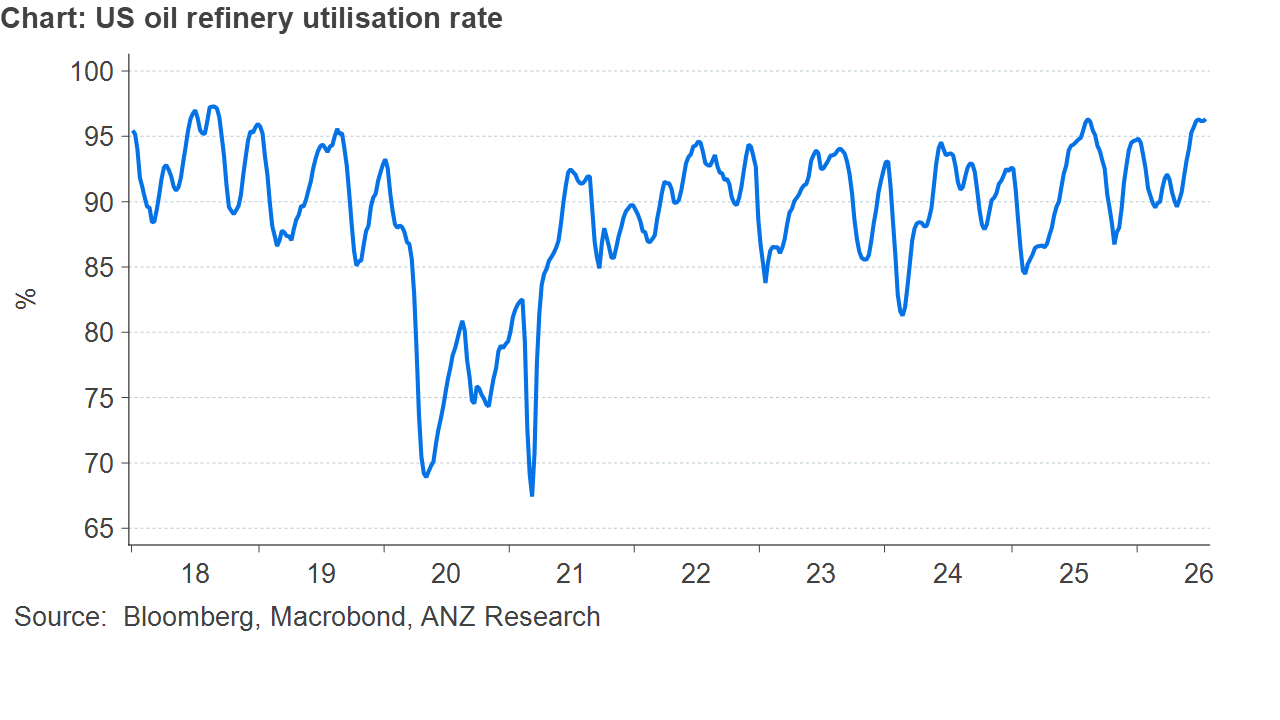
US refiners pushed processing rates to the highest level since September 2019, incentivised to run harder by record wide margins and strong foreign demand. Running at 97.1%, US refineries were about to process 17.3mbbls last week. Runs reached an all-time record of 101.4% in the Midwest.
However, refining has become the real supply side constraint. Additional gains in the US are unlikely given the levels they are currently processing. Globally, we have elevated unplanned outages. Russian throughput has hit a two-decade low after recent drone strikes. China has capped export quotas as a result of disruptions in the Middle East. Overall, refined product markets remain considerably tighter than crude oil fundamentals.
5in5 with ANZ Podcast
