
Summary
Energy gained amid threats to Red Sea oil flows. Signs of stronger demand supported industrial metals. Precious metals gained despite the spectre of higher rates.
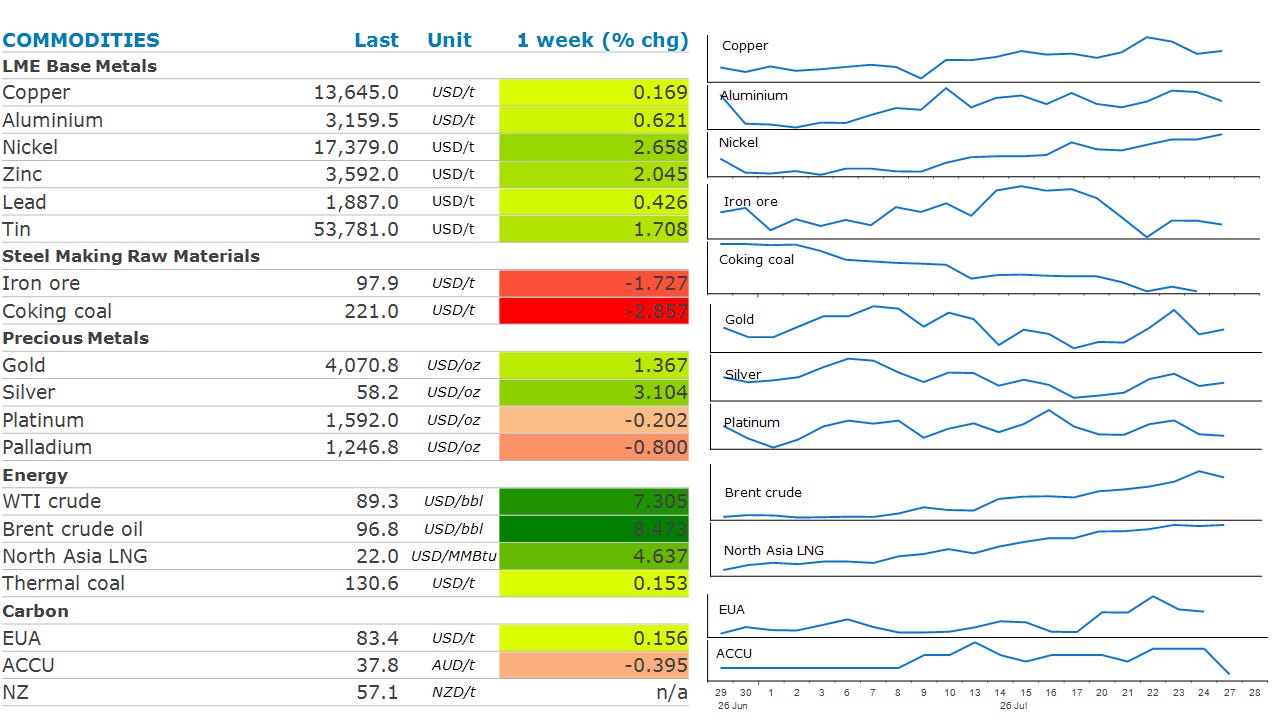
Prices and commentary accurate as of 07:00 Sydney/05:00 Singapore/17:00(-1d) New York/22:00(-1d) London.
Ahead Today
Public holidays: None
Central bank speakers: None
Economic data: China: industrial profits; Germany: IFO business climate; Hong Kong: trade; Japan: leading index; Mexico: trade; Pakistan: rate decision; Singapore: industrial production, monetary policy statement; US: durable goods orders (8:30am NY / 1:30pm UK / 10:30pm AEDT), Dallas Fed manufacturing
Commodities reports: None
Events: ECOFIN budget session in Brussels; Philippine President Ferdinand Marcos Jr. State of the Nation address; Legislative elections in Pakistan-administered Kashmir; CXMT listing on Shanghai STAR Market; Gordie Howe International Bridge opening; Galp 2Q earnings; Saipem 2Q earnings
Market data: None
Listen to today’s 5in5 with ANZ podcast for more on the global economy and markets.
Market Commentary
Crude oil surged higher last week as the Middle East conflict escalated, raising concerns of further supply disruptions. Brent crude touched USD100/bbl after the Iran-backed Houthi militant group said it attacked two Saudi Arabian oil tankers near the Bab al-Mandab Strait. This threatened to widen the impact on Persian Gulf oil exports. The market is also contending with attacks on the Caspian Pipeline Consortium terminal, which has put at risk nearly 1.8mb/d of oil supply from Kazakhstan. Brent crude gave up some of the week’s gains on Friday after reports that Pakistan was exploring efforts to revive peace talks, while the US military abruptly stopped attacks on Iran for the first time in 12 days.
The oil market has been cushioned by China’s sharp reduction in crude imports, emergency stock releases and Saudi Arabia’s East-West Pipeline, but these supports are finite and increasingly vulnerable as tensions escalate. A disruption to Red Sea and Bab al-Mandab shipping would undermine one of the market’s most important workarounds, accelerating inventory drawdowns, tightening physical and product markets, and increasing reliance on strategic reserves and demand destruction. We still view the current escalation as part of the expected uneven recovery in Persian Gulf oil flows. However, if regional supply disruptions intensify as market buffers weaken, there could be further upside to oil prices.
European natural gas recorded its fourth consecutive week of gains as the spectre of persistent supply disruptions increased. The escalation of the Middle East conflict has cast doubt on any near-term resumption of shipping from the region. For Europe, ongoing restrictions on LNG flows from Qatar mean it will have to compete hard for available cargoes. This has been compounded by strong demand in Asia, and higher than normal temperatures, which have boosted gas-fired power consumption. This will challenge Europe’s ability to refill storage before the heating season begins. European gas storage levels are currently only 54%, compared with the five-year seasonal average of 70%. Asia LNG prices also rose sharply after Qatar informed Bangladesh’s state-owned importer that it will extend force majeure on shipments scheduled for delivery through mid-September.
Gold edged higher, holding above the key resistance level of USD4,000/oz despite higher energy prices threatening to trigger central bank rate hikes. Swap traders currently see a 34% chance that the Fed will lift rates at its next meeting. However, the announcement that the US will start collecting duties of 10% to 12.5% on imports from most trading partners added to uncertainty around monetary policy.
Base metals fluctuated as the escalation in the Middle East conflict threatened to dampen recent optimism over the global economy and demand for key metals. In China, the premium paid for imported copper over local supplies in China rose to USD100/t, up from USD20/t in late January, a sign of strong demand. The market is also bracing for the possibility that the Trump administration imposes levies on imports of copper, which continues to attract increasing volumes of metal into the US.
Chart of the Day
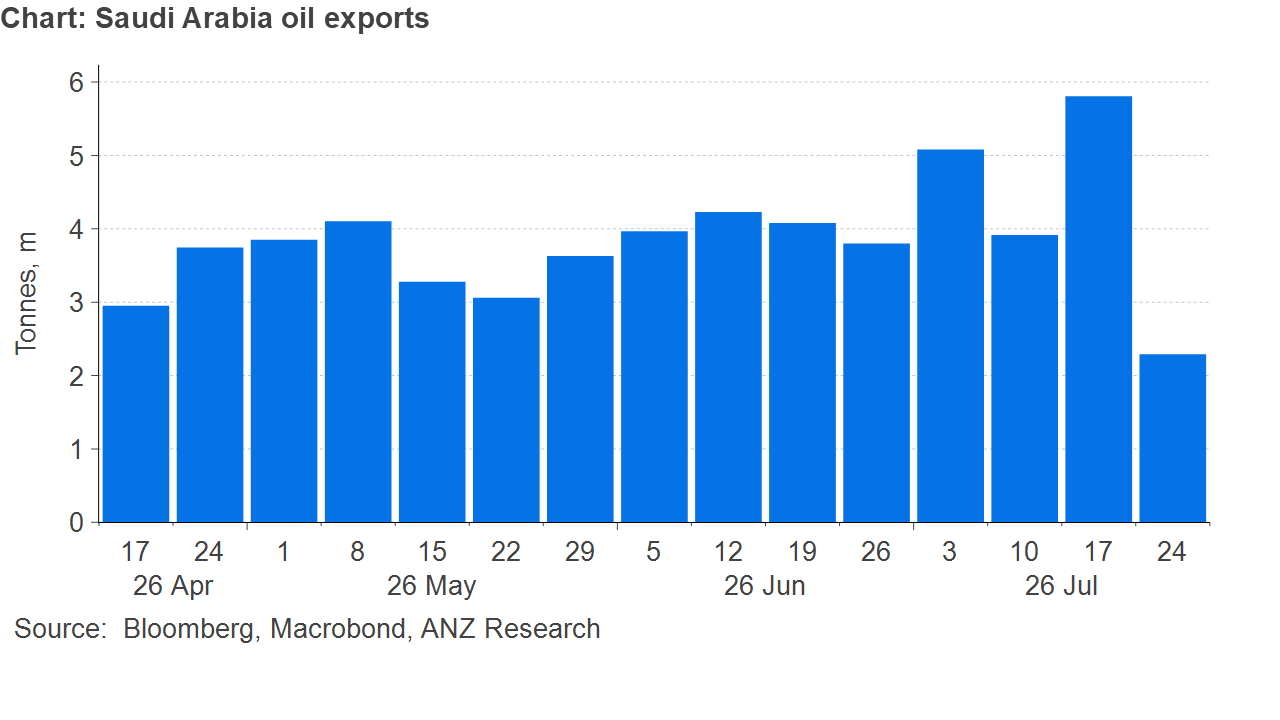
Saudi Arabia’s oil exports appear to have already been impacted by the Houthi rebels attacks in the Red Sea. Volumes fell to 2.29mb/d last week, according to Bloomberg ship tracking data. That’s the lowest level since the Middle East conflict started in late February.
5in5 with ANZ Podcast
