Commodities Wrap: Oil slumps as tensions ease in the Middle East
Tuesday 28 July, 2026


Summary
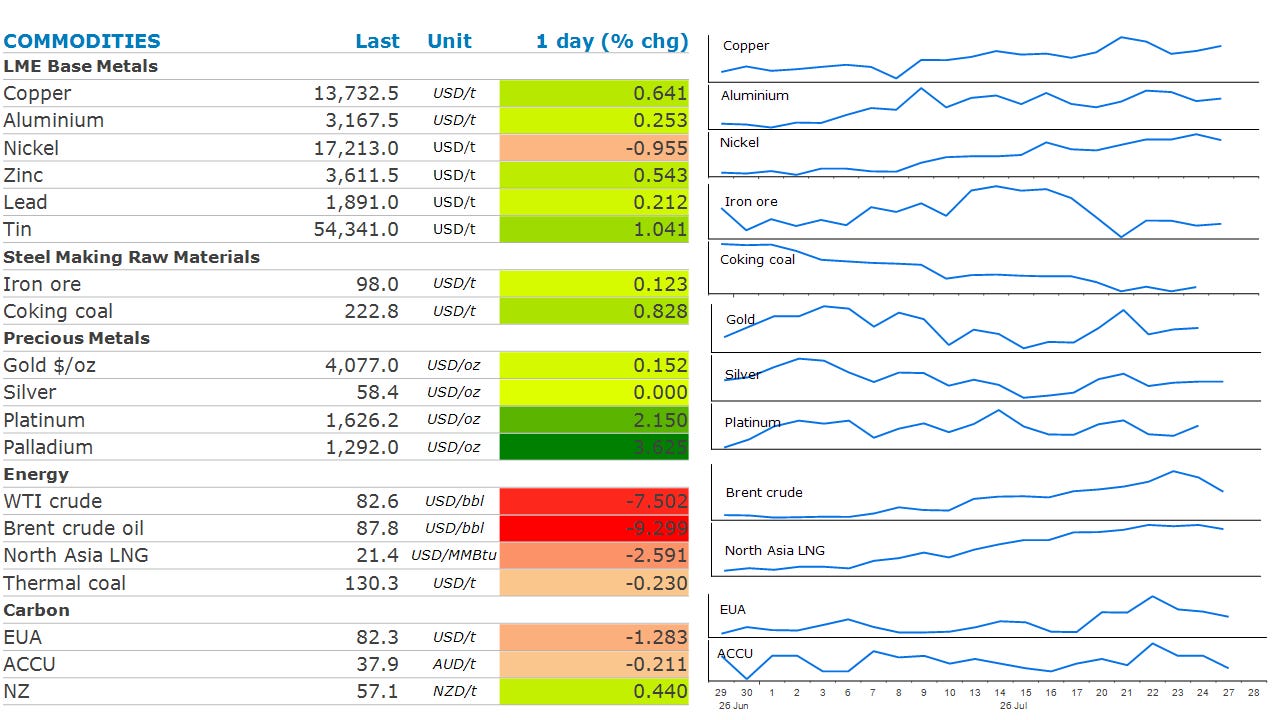
Easing tensions in the Middle East weighed on the energy sector. This triggered an improvement in risk appetite, with industrial and precious metals gaining.
Prices and commentary accurate as of 07:00 Sydney/05:00 Singapore/17:00(-1d) New York/22:00(-1d) London.
Ahead Today
Tuesday 28 Jul
Public holidays: Thailand
Central bank speakers: RBA Governor Michele Bullock at Anika Foundation Fundraising Lunch, Sydney
Economic data: Chile: rate decision; India: industrial production; Mexico: international reserves; South Korea: consumer confidence; Sri Lanka: trade; US: ADP employment change (8:15am NY / 1:15pm UK / 10:15pm AEDT), wholesale inventories (8:30am NY / 1:30pm UK / 10:30pm AEDT), Conference Board consumer confidence, FHFA house price index
Commodities reports: API weekly US oil inventories (4:30pm NY / 9:30pm UK / 6:30am AEDT next day)
Events: Boeing earnings; Barclays earnings; Tribute to Senator Lindsey Graham in Washington; Keiko Fujimori inaugurated as Peru President; Fortune Global 500 ranking released; CenterPoint Energy 2Q earnings; DTE Energy 2Q earnings; FirstEnergy 2Q earnings
Market data: Brent September options expiry
Listen to today’s 5in5 with ANZ podcast for more on the global economy and markets.
Market Commentary
Crude oil slumped following reports that the US and Iran were working towards another peace deal. The US has apparently held off on striking Iran since Friday following 13 consecutive nights of attacks. Iran has also signalled that it is refraining from retaliation and has held talks with Oman over the Strait of Hormuz, according to Bloomberg. US President Donald Trump said that he decided to pause the strikes to give negotiations another chance. This saw Brent crude fall more than 9% to end the session around USD88/bbl. This sell-off was exacerbated by reports that oil loading has resumed at the Caspian Pipeline Consortium terminal on Russia’s Black Sea coast, where vessels had been under attack from Ukrainian drones last week.
Nevertheless, the risks to supply disruptions spreading to the Red Sea remain elevated. Saudi Arabia reported that it had intercepted several drones that were launched from Iraq by Iran-backed militias that were heading towards petroleum facilities in its eastern region. These attacks are threatening this critical alternative route, with Bab al-Mandab crude and product flows falling to 2.6mb/d in July from 5.5mb/d in June. Also, transits through the Strait of Hormuz have all but dried up, underscoring the severity of supply disruptions in the Persian Gulf. Both inbound and outbound vessel crossings have fallen to less than 0.5 per day on a seven-day moving average basis. Ongoing disruptions reinforce concerns that supply losses could become more significant if shipping conditions deteriorate further.
Global gas prices fell alongside the sell-off in crude oil. European natural gas benchmark futures sank as much as 11% as tensions eased in the Middle East. In Asia, spot LNG prices fell nearly 3%. The falls came amid signs that LNG exporters are resuming efforts to get cargoes onto the international market. Four LNG vessels anchored near the UAE at the eastern entrance to the Strait of Hormuz turned their transponders off, a sign in the past that has led to vessels attempting to cross the key waterway. However, those efforts may be isolated. QatarEnergy is still offering to subcharter an LNG carrier through the end of October, suggesting it’s in no rush to bring tankers back to the Persian Gulf. In the meantime, South Asian importers are actively purchasing additional LNG cargoes as lower supply from Qatar has left them scrambling for replacement volumes.
The pause in fighting also boosted sentiment across the base metals sector. Copper led the gains as the subsequent fall in the USD enticed investors back. This was aided by further signs of tightness in the physical market. Copper inventories held in Shanghai Futures Exchange warehouses fell to 300kt, their lowest level since February and down from April’s peak of 520kt. China’s copper fabrication operating rates have eased after the post-Lunar New Year rebound, yet aggregate rates above 70% remain slightly ahead of last year, pointing to resilient demand. Gold also gained as the fall in oil prices eased inflationary concerns that had been threatening tighter monetary policy.
Iron ore futures declined on ongoing oversupply concerns. Imported iron ore inventories at Chinese ports have stayed elevated at 170mt this year, more than 30mt higher than the same period last year. Inventories at Chinese steel mills also rose 8% last week to 18.1mt in mid-July.
Chart of the Day
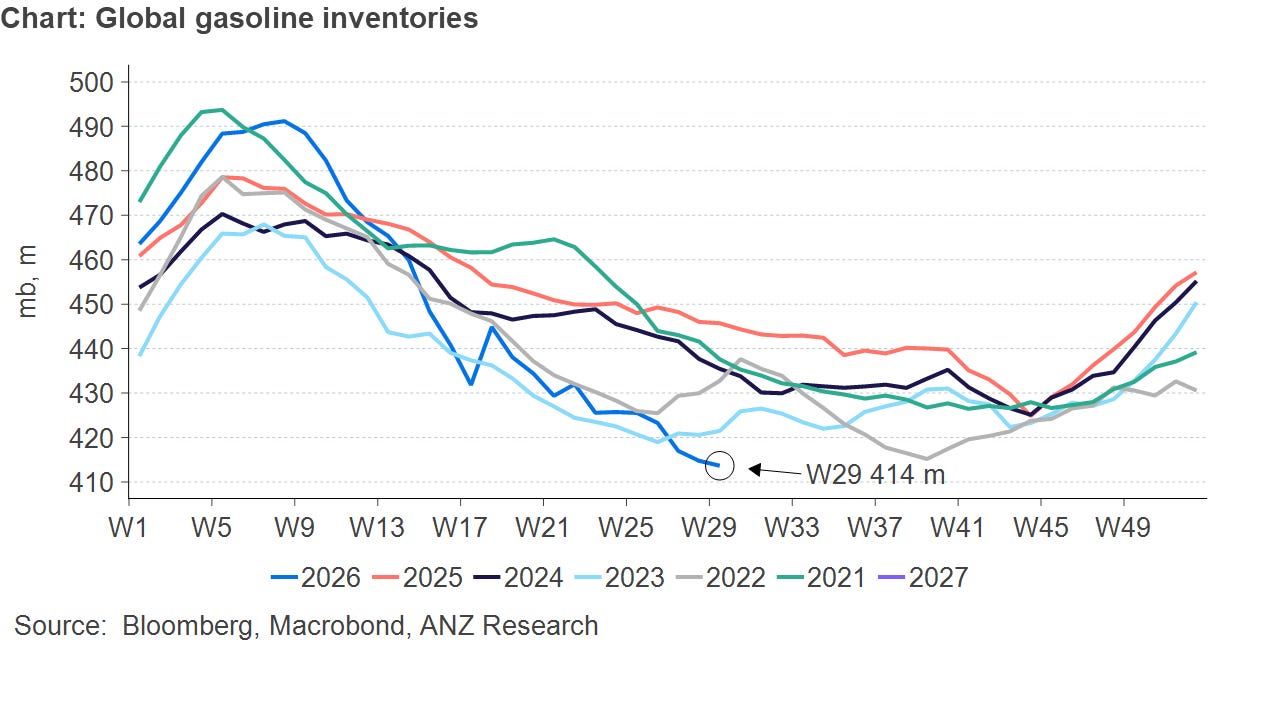
Global inventories of gasoline continue to fall as demand outpaces the rise in refinery utilisation rates. In the US, Midwest refiners are operating at maximum capacity. Refinery run rates have consistently held above 99% since mid-June. This comes amid strong gasoline demand, the EIA data showed. The seasonal demand from summer driving in Europe has also been exacerbated by disruptions to regional trade flows, such as the widespread refinery outages in Russia.
5in5 with ANZ Podcast
