Commodities Wrap: Oil extends losses as Persian Gulf supply flows resume
Friday 19 June, 2026

Summary
Prospects of tighter monetary policy weighed on sentiment across precious and industrial metals. Energy fell as supplies picked up from the Persian Gulf.
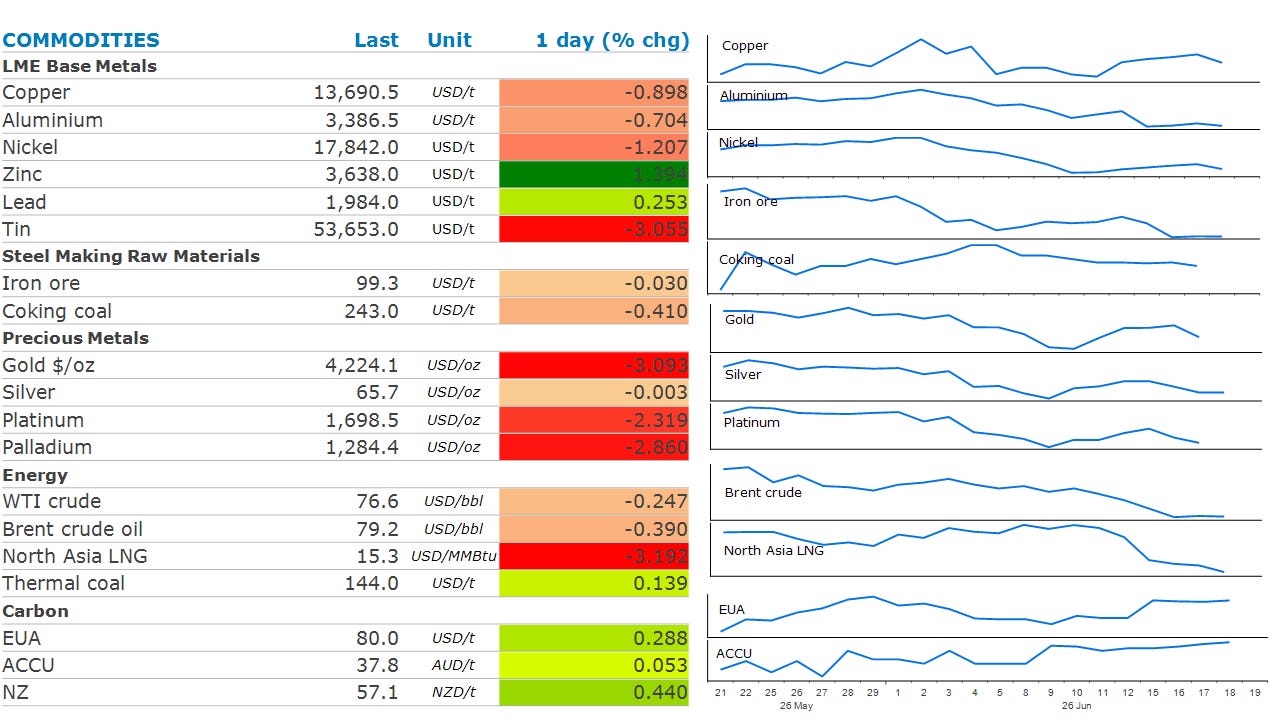
Prices and commentary accurate as of 07:00 Sydney/05:00 Singapore/17:00(-1d) New York/22:00(-1d) London.
Ahead Today
Public holidays: China; Hong Kong; Taiwan; US (Juneteenth)
Central bank speakers: Russia CB Nabiullina press conference; ECB Lane Paris
Economic data: Canada retail sales; Japan CPI, BOJ minutes; Malaysia trade, CPI; New Zealand trade; Philippines balance of payments; Russia rate decision, gold reserves; South Korea PPI; UK retail sales
Commodities reports: Shanghai exchange weekly inventories (~15:30 local); ICE Futures Europe COT report (18:30 London / 13:30 NY / 03:30 AEDT); CFTC COT delayed to 22 Jun
Events: Africa Energy Forum final day; Reliance AGM; Australia parliamentary hearing (KPMG audit)
Market data: CME and ICE holiday schedules
Listen to today’s 5in5 with ANZ podcast for more on the global economy and markets.
Market Commentary
Crude oil prices resumed their downward path as the US-Iran interim peace deal took effect and Persian Gulf oil supplies resumed flows. A flurry of tankers have taken the chance to exit the gulf through the Strait of Hormuz, as Iran loosens its grip on the key waterway under conditions stipulated under the agreement. The US also declared an end to its naval blockade. Iran’s President Pezeshkian announced the commercial vessel traffic at southern ports had returned to normal since Monday. According to ship tracking data, at least four supertankers, including three controlled by Saudi Arabia’s Bahri, were observed leaving the strait, along with a ship carrying LNG and a Chinese fuel tanker. Now begins the difficult period of negotiations regarding Iran’s nuclear program, which will see some level of caution remain. US Defense Secretary Hegseth said that if Iran doesn’t comply, the US is more than able to reimpose an ironclad blockade. President Trump also said he might back Israel if it attacked Iran.
Any recovery in supply is well needed, according to OPEC. In its latest market report, it expects global oil demand to rise to 113.3mb/d by 2030. OPEC member Kuwait said it has already started the process of restarting oil output that was suspended due to the closure of the strait. Kuwait Petroleum Corp’s CEO, Sheik Nawaf Al-Sabah, said he expects output will reach 2mb/d within a week from now, depending on the availability of commercial ships. That may take time, with several shipping companies saying work on removing mines from the strait needs to be done before they return. They are also concerned about whether the waterway will remain toll-free after the 60 days stipulated in the US-Iran agreement.
LNG prices dropped on signs of supply flowing through the Strait of Hormuz. Qatar brought an empty LNG tanker back into the Persian Gulf through the strait for the first time since the Middle East conflict escalated in late February. Qatar is aiming to restart most of its export capacity within two months of reopening. However, earlier this week it said that the remaining capacity will take years to fully restore. European benchmark natural gas futures fell to their lowest level in more than two months. The reopening could help Europe, Germany in particular, replenish its depleted gas inventories ahead of the next winter heating season. So far, warmer temperatures in Asia have pushed demand higher, thus increasing competition for limited LNG cargoes.
Gold slipped further as a more hawkish Fed outweighed relief from the US-Iran deal. Fed Chair Warsh this week vowed to restore price stability after the FOMC left rates unchanged and signalled growing support for interest rate hikes. That hawkish tilt has overshadowed any respite the preliminary US-Iran agreement provided.
Copper led the base metals higher, as the prospect of tighter monetary policy dented sentiment. The outlook for US interest rates has a global bearing on commodity markets, with higher rates raising costs for importers. Nevertheless, the losses were limited by expectations of strong demand. The surge in investment in infrastructure required to connect data centres to the grid in the US and elsewhere is expected to boost consumption. Renewed supply side issues also provided some support. Protestors blocked copper exports from the Oyu Tolgoi mine in Mongolia.
Chart of the Day
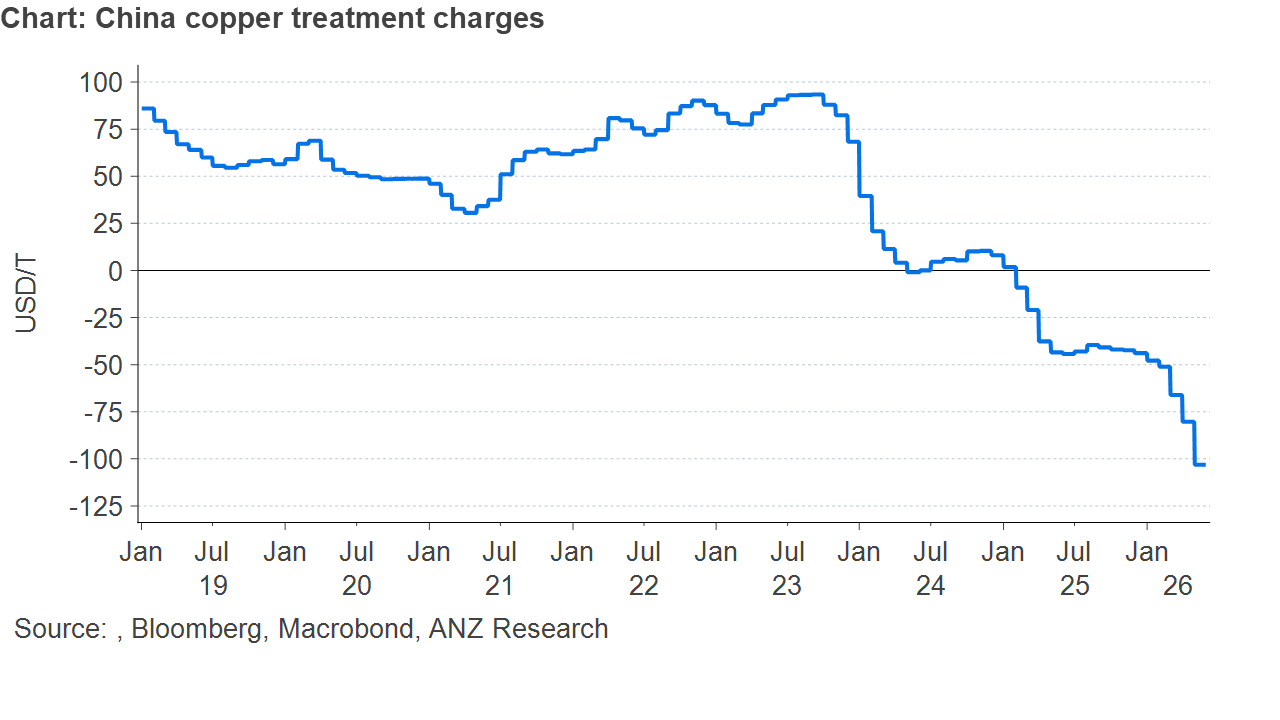
Recent tightness in the copper mine market is showing no signs of abating. The structural tightness is driven by an imbalance between custom concentrate supply and demand, as additions to smelter capacity have outpaced new supply additions since 2022. While China has led the expansion of primary smelting capacity, new integrated smelters in the rest of the world have removed over 1mt of custom copper in concentrate supply from the market. Smelters, facing insufficient contract coverage, increased spot purchases, pushing treatment charges (TCRCs) deeply negative. By May 2026, TCs for smelter purchases fell below US$-100/t for the first time.
5in5 with ANZ Podcast
