
Summary
Energy pushed higher amid further escalation of the Middle East conflict. Precious metals gained despite inflationary concerns. Industrial metals were also higher.
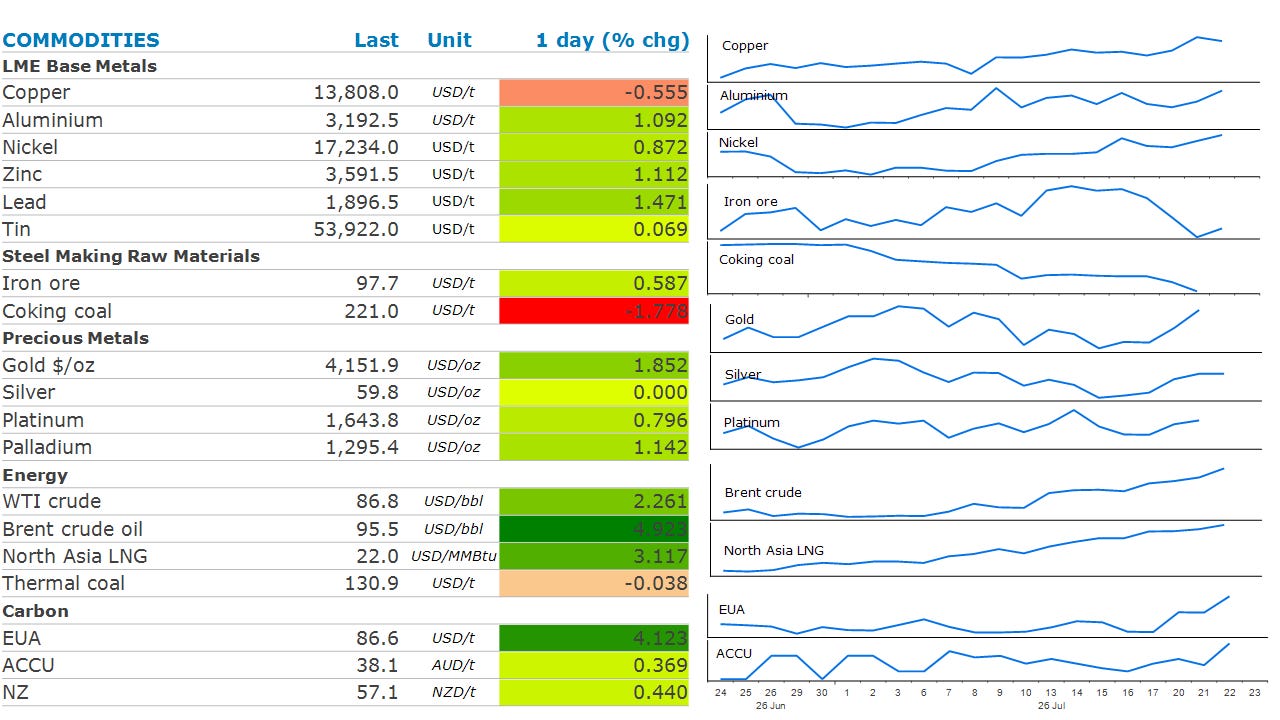
Prices and commentary accurate as of 07:00 Sydney/05:00 Singapore/17:00(-1d) New York/22:00(-1d) London.
Ahead Today
Public holidays: Egypt; Israel
Central bank speakers: ECB President Christine Lagarde press conference following ECB decision
Economic data: Australia: unemployment; Canada: retail sales; Eurozone: ECB rate decision, consumer confidence; Singapore: CPI; South Africa: rate decision; South Korea: GDP; Taiwan: industrial production; Turkey: rate decision; US: initial jobless claims, Chicago Fed activity index
Commodities reports: Singapore weekly onshore oil-product stockpiles; Insights Global weekly ARA oil-product inventories; EIA weekly US natural gas inventories (10:30 NY / 15:30 UK / 00:30 AEDT); Anglo American production report; SHFE warrant change data (after market close); LME inventory and warrant data (~09:00 UK / 04:00 NY / 18:00 AEDT)
Events: Candidates for UN Secretary-General participate in UN General Assembly town hall in New York; Vale Extraordinary General Meeting
Market data: ECB interest-rate decision announced (08:15 NY / 13:15 UK / 22:15 AEDT)
Listen to today’s 5in5 with ANZ podcast for more on the global economy and markets.
Market Commentary
Crude oil prices extended gains as hopes of an end to the current attacks in the Middle East faded. Earlier this week, mediators had indicated a 10-day ceasefire proposal was on the table. However, Iran said that there are currently no negotiations and only an exchange of messages possible. Meanwhile, the hostilities between the US and Iran continued unabated. Another tanker, the Kaifan, was attacked in the Strait of Hormuz, according to the security consultancy EOS Risk Group. Iran reiterated that using alternative routes not designated by Iran for safe passage through the strait will bring heavy and irreversible consequences. President Trump warned of retaliation for Iranian attacks on ships and vowed to respond if the Iran-backed Houthis in Yemen disrupted shipping in the Red Sea.
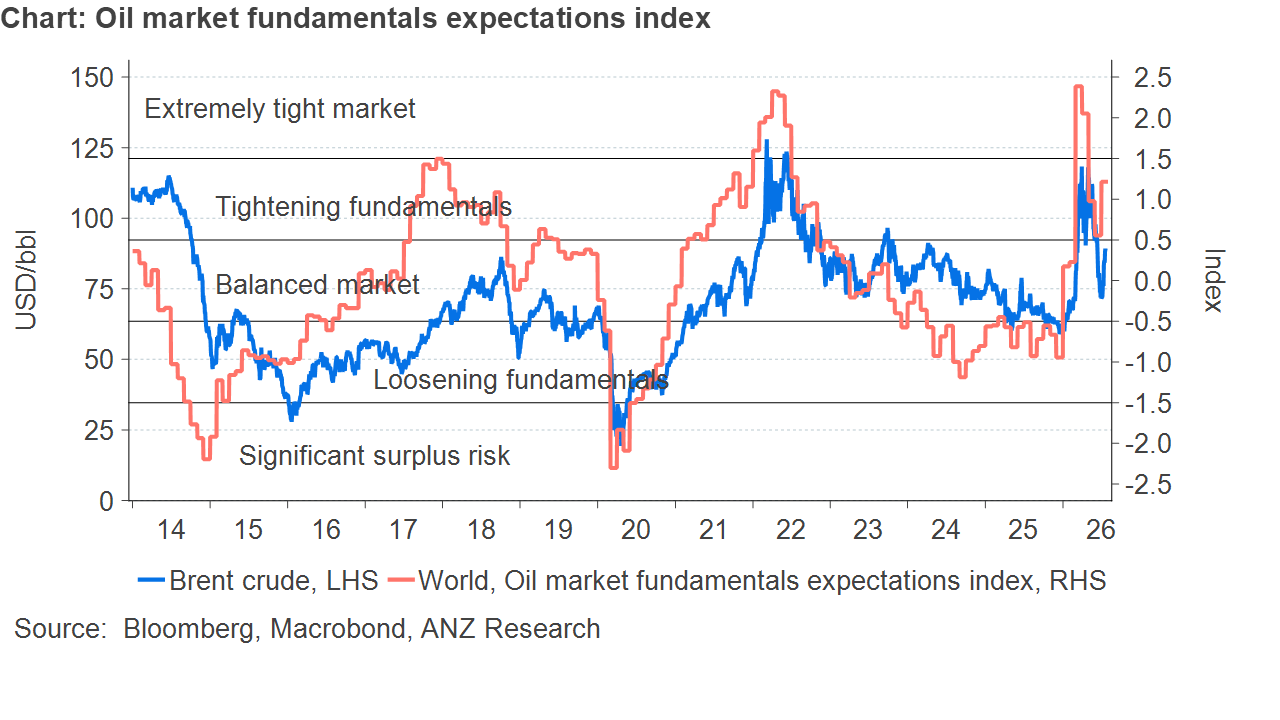
The recent escalation in the Middle East conflict has seen Brent crude futures rebound sharply. Since the start of July, they have gained nearly 30%. Oil prices are increasingly shaped not only by observed fundamentals but by what the market believes fundamentals will look like over the next 6–12 months. Our new Oil Market Fundamentals Expectations Index provides a cross-market gauge of those expectations by aggregating signals from time spreads, inventories, refining margins, physical differentials and spare capacity. It shows the market has moved back into a tightening regime after briefly returning to balance in June, suggesting that oil prices are vulnerable to abrupt shifts in perceived supply risk and product-market tightness.
Global gas prices rose alongside oil as fears mount over supply shortages. Europe is running out of time to replenish its gas reserves ahead of next winter. Storage facilities are just 54% full versus a typical level of about 68% at this time of the year. They need to reach 90% by November. High natural gas prices are bringing other issues. Power prices in Europe are surging, forcing governments to apply fiscal measures to cushion the impact on consumers. Competition for LNG is going to intensify as high temperatures in Asia increase demand. Hope of Qatar resuming its plan to boost exports appears to be fading. It is offering to sub-charter its LNG tankers near the US coast, indicating it is not in a rush to bring the ships back to the Persian Gulf.
Gold found support from investors, despite the rising energy prices risking a shift towards tighter monetary policy. Concerns over inflation and higher interest rates tend to dim gold’s appeal. Instead, investors appear keen to use the recent selloff to rebuild positions at lower prices. CFTC data show the net long position of non-commercial buyers at its highest level since January this year. The support may be coming from concerns over the elevated valuations in the equity markets. This has led to some renewed buying in gold-backed exchange traded funds to mitigate any selloffs.
The base metals sector was broadly higher as a slightly weaker USD helped boost investor appetite. Signs of tightness in markets such as copper have also boosted sentiment. The premium paid for copper over local supplies in China rose to USD100/t, up from a low of USD20/t in late January. There are also some mounting concerns of supply disruptions. Severe storms in Chile are threatening to disrupt copper production.
Chart of the Day
The index has a relatively good correlation with oil prices over the past 30 years, reflecting shifting expectations amid major events such as the GFC, COVID-19 and Russia-Ukraine conflict. The close relationship between the OMFEI and oil prices suggests market-implied expectations of physical fundamentals have become an important driver of price formation, particularly during periods of elevated uncertainty.
5in5 with ANZ Podcast
