
Summary
The energy sector rose after more attacks in the Middle East. Precious metals rallied as fears of rate hikes eased. Industrial metals also gained.
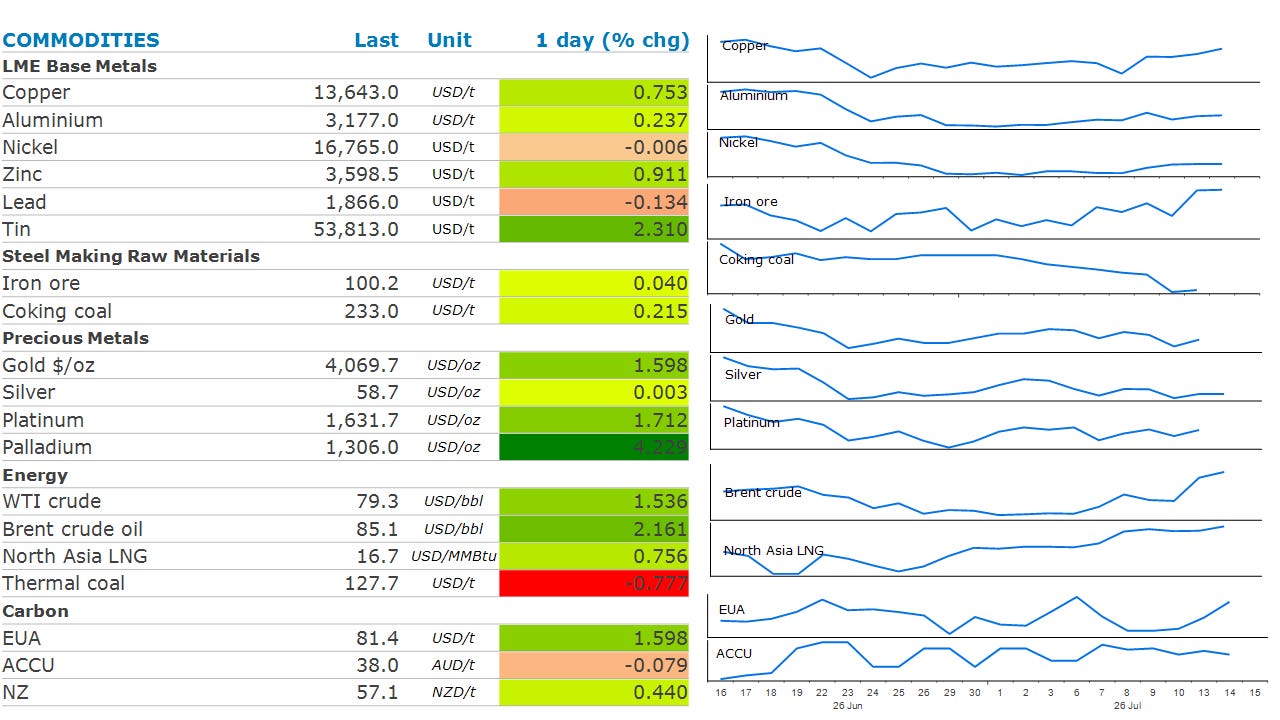
Prices and commentary accurate as of 07:00 Sydney/05:00 Singapore/17:00(-1d) New York/22:00(-1d) London.
Ahead Today
Public holidays: Turkey.
Central bank speakers: Fed – Kevin Warsh testimony before Senate Banking Committee; Fed – Lisa Cook speaks on economic outlook; Fed – John Williams speaks in New York; Fed – Alberto Musalem remarks at Homer Jones Memorial Lecture; BOE – Huw Pill panel discussion; Bank of Canada – Tiff Macklem press conference following rate decision; ECB – Fabio Panetta speaks in Rome.
Economic data: Canada – Bank of Canada rate decision, existing home sales; China – Q2 GDP, retail sales, property prices, industrial production, fixed asset investment; Eurozone – industrial production (06:00 NY / 11:00 UK / 21:00 AEDT); Israel – CPI; Japan – machinery orders, tertiary industry index; Nigeria – CPI; Philippines – overseas remittances; Poland – CPI; Saudi Arabia – CPI; South Korea – unemployment; Spain – CPI; Sweden – CPI; US – Empire Manufacturing (08:30 NY / 13:30 UK / 23:30 AEDT), PPI (08:30 NY / 13:30 UK / 23:30 AEDT), Fed Beige Book (14:00 NY / 19:00 UK / 05:00 AEDT 16 Jul).
Commodities reports: China coal production, gas production, power generation, crude oil production and refining output; Genscape ARA crude inventories (04:00 NY / 09:00 UK / 19:00 AEDT); EIA weekly US oil inventories, supply and demand (10:30 NY / 15:30 UK / 01:30 AEDT 16 Jul).
Events: US Financial Stability Oversight Council meeting on geopolitical risks, AI and financial stability.
Market data: Aker BP earnings; Morgan Stanley earnings; United Airlines earnings; ASML earnings
Listen to today’s 5in5 with ANZ podcast for more on the global economy and markets.
Market Commentary
Crude oil prices extended recent gains as more vessels came under attack in the Strait of Hormuz. Two United Arab Emirates-linked oil tankers were struck, marking a direct attack on one of the biggest exporters in the region. US broadcaster ABC reported fresh US airstrikes on Iran, while Iran’s semi-official Fars news agency reported multiple explosions were heard on the country’s Qeshm Island. There were also reports that Iran launched missiles and drones at Kuwait and Bahrain. Oman said a tanker was targeted outside its waters. Observable traffic in the strait all but ceased on Tuesday, ship tracking data shows. It is possible that vessels have been crossing the strait with their transponders turned off. However, the recent attacks on ships by both Iran and the US are making these journeys increasingly risky.
The impact on the recovery phase of the supply disruptions will be immense. Based on ship tracking data, Iran was able to ship at least 2.2mb/d during the period when the US had waived sanctions on the Iranian oil industry and removed the blockade. Now that its back in place, Iran will struggle to export at such levels. Other Persian Gulf producers will also have to reevaluate their efforts to ramp up production. The control of the waterway remains the sticking in negotiations between the US and Iran. Both sides have been reluctant to back down on their demands. Iran’s Deputy Foreign Minister reiterated yesterday that “in wartime conditions, out control of must extend across the entire Straif of Hormuz, not just our side”. However, the US did show signs it is willing to compromise. Trump backed away from his plan to impose a 20% charge on cargo shipments through Hormuz.
European natural gas futures rose to their highest level in two months as the attacks on vessels in the strait raised concerns about security of supply. The attack on a Qatari LNG tanker has shaken the confidence of the biggest LNG exporters in the Middle East. This will undoubtedly increase the difficult process of refilling storage facilities in Europe ahead of the next winter heating season. The continent will have to compete with an even hungrier Asia, where high summer temperatures have increased demands from the electricity sector for gas-fired power. That was reflected in China’s latest commodity trade data. Imports of gas in June continued to recover, rising to 10.9mt, although year-to-date volumes contracted. North Asia LNG prices have subsequently risen above USD18.5/MMBtu. The number of importers seeking additional spot cargoes has increased sharply in recent weeks.
Gold rebounded from yesterday’s selloff, as cooler-than-expected US inflation data eased fears that the Fed will need to raise interest rates in the near term. After rising more than 2.5%, it gave back some of those gains after Fed Chair Warsh downplayed the inflation figures.
The diminishing prospects of a rate hike boosted sentiment across the base metals sector. Copper led the sector higher, and zinc and aluminium rose. Supply disruptions in the Middle East have seen China boost exports of aluminium, with June volumes up 45% y/y to 710kt. Lead bucked the trend to end the session lower after a record delivery of lead entered LME warehouses in Singapore. Iron ore also gained after trade data showed strong demand in China. June imports rose sharply to 112.7mt, the highest level in several months
Chart of the Day
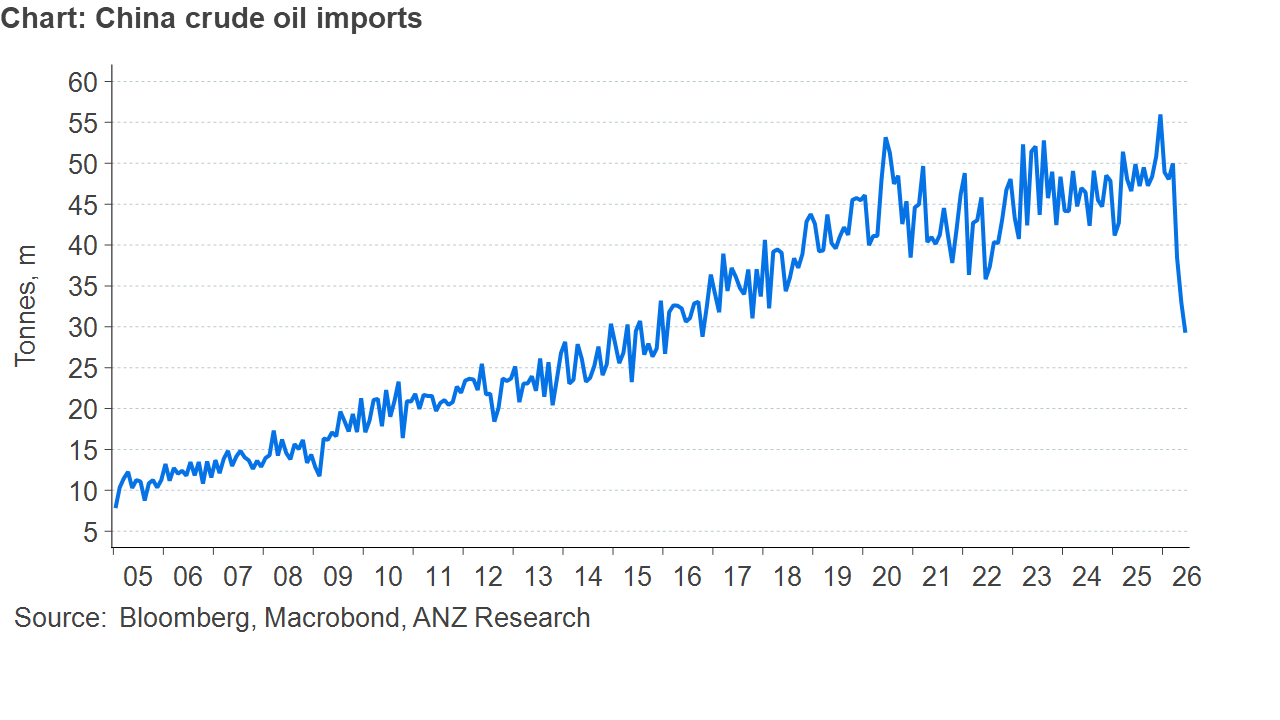
Crude oil imports fell to 29.3mt in June from 33.1mt in May, marking a decline of 41.3% y/y. The weakness likely reflects the move by China to mitigate the impact of the supply disruptions in the Middle East. Prior to the US-Iran conflict, China was importing around 55mt per month. The dramatic fall is equivalent to nearly 5mb/d that China has curtailed demand by. That’s gone a significant way to offsetting the losses from the Persian Gulf..
5in5 with ANZ Podcast
