
Summary
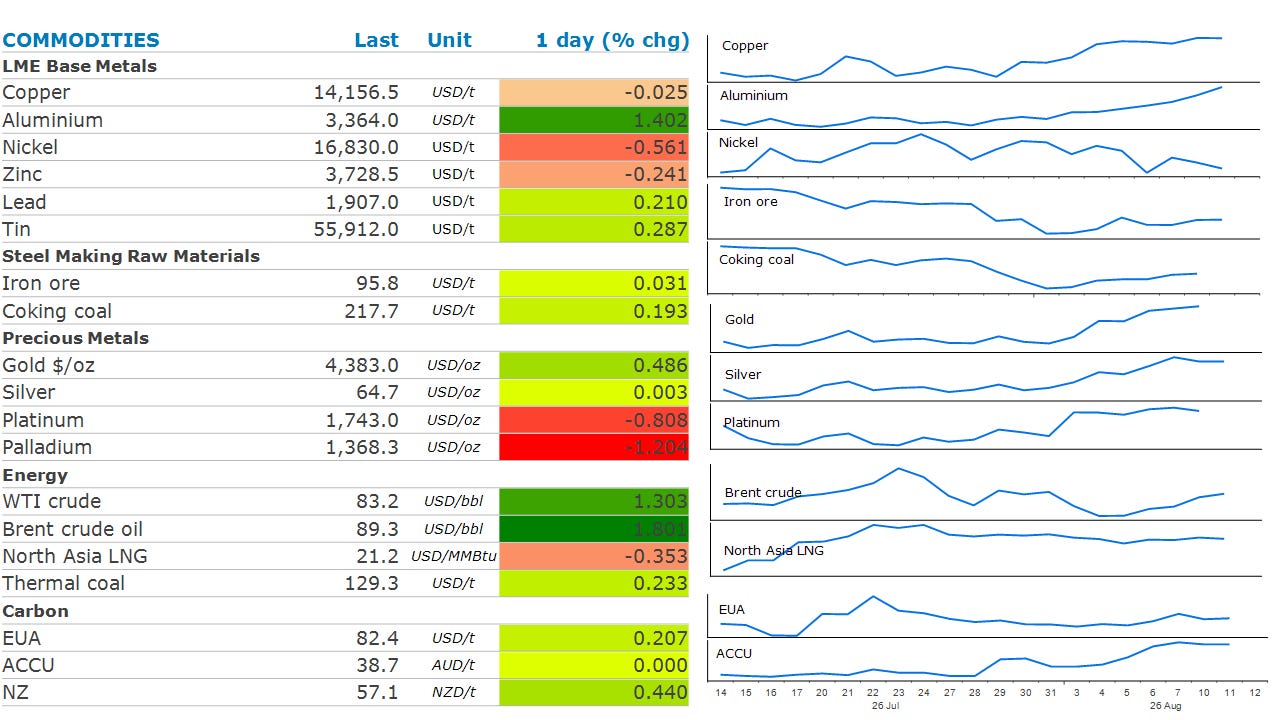
Mixed signals on a deal to reopen the Strait of Hormuz saw energy prices gain. Industrial metals rose on further supply side issues.
Prices and commentary accurate as of 07:00 Sydney/05:00 Singapore/17:00(-1d) New York/22:00(-1d) London.
Ahead Today
Public holidays: Thailand
Central bank speakers: None scheduled
Economic data: Germany CPI; India CPI; Italy CPI; Japan money stock and machine tool orders; Russia CPI and GDP; Saudi Arabia CPI; South Korea unemployment; US CPI (8:30am NY / 1:30pm UK / 10:30pm AEDT), federal budget balance and mortgage applications
Commodities reports: Genscape ARA crude inventory report (4:00am NY / 9:00am UK / 6:00pm AEDT); IEA monthly Oil Market Report (4:00am NY / 9:00am UK / 6:00pm AEDT); OPEC Monthly Oil Market Report; EIA weekly US oil inventories, supply and demand report (10:30am NY / 3:30pm UK / 12:30am AEDT Thu); USDA WASDE world agricultural supply and demand report; LME inventory and warrant data (4:00am NY / 9:00am UK / 6:00pm AEDT); SHFE warrant change data
Events: Norway sovereign wealth fund half-year results and press conference (5:00am NY / 10:00am UK / 7:00pm AEDT); Google “Made by Google” product launch in New York; July US CPI report in focus for markets; Total solar eclipse visible from Greenland, Iceland, northern Russia, Spain and Portugal
Market data: ICE Gasoil August futures expiry
Listen to today’s 5in5 with ANZ podcast for more on the global economy and markets.
Market Commentary
Oil extended gains as the likelihood of a deal to reopen the Strait of Hormuz remain low. Pakistan’s defence minister said that the US and Iran are close to “some sort of arrangement” on Hormuz. Al Jazeera reported that talks between Oman and Iran had reached an advanced stage, but Iran insisted that the waterway will remain closed until the US meets its demands, which include the removal of a blockade of Iranian ports and compensation for damages inflicted by US military attacks. Meanwhile, skirmishes in the Middle East keep traders on edge. A US Navy helicopter fired missiles at a Panama-flagged cargo vessel that was attempting to transit the Gulf of Oman. A refinery in Libya was also targeted by a drone attack. The collapse of the US-Iran peace deal has seen oil flows from the Persian Gulf once again dry up. The Strait of Hormuz remains heavily constrained, with vessel traffic showing no meaningful recovery. The US blockade is also weighing on Iranian exports. Its oil terminals appeared largely idle this month, with no supertankers visible at Kharg Island, its main export terminal. Kpler estimates that exports are down roughly 40% this month compared with their average in July, to about 500kb/d.
Ongoing disruptions to Russian oil supplies are compounding oil market tightness. After a hiatus, Ukraine resumed drone attacks on Russian oil refineries. This has seen Russia’s crude shipments drop to their lowest level since May. Total exports fell to 3.71mb/d in the four weeks to 9 August, according to ship tracking data.
Natural gas prices in Europe and Asia were down early in trading on signs of a possible restart of exports from Qatar. The world’s biggest LNG exporter was loading the most LNG in months, with a 10-day moving average of loadings from the Ras Laffan complex of about 10kt. However, the eventual exports remain dependent on shipping conditions through the Strait of Hormuz. The subsequent warnings from Iran that Hormuz will remain closed until its demands are met saw those markets give back most of the losses by the end of the session. Europe’s LNG imports have been falling since April on the disruptions in the Middle East. That has put out of reach its target of refilling storage facilities back to 90% before the start of the heating season. A lower target of 70% remains a challenge. German’s Uniper SE said it can still be reached but that it remains reliant on a resolution in the Middle East conflict.
Traders in base metal markets were faced with a barrage of supply side issues. Aluminium prices rallied after Norsk Hydro said its Alunorte alumina refinery in Brazil cut its output to 50% due to natural gas supply shortages due to the closure of the Strait of Hormuz. Norsk Hydro warned last month that the annual supply shortfall may widen to more than 900kt if trade through the key waterway is not normalised. In Indonesia, copper shipments from the giant Grasberg mine were halted because of a boiler leak over the weekend.
Gold remained near a two-month high as traders look to the release of key US inflation data. This comes amid the backdrop of higher energy prices, as a deal to reopen Hormuz fades. Sentiment was supported by data showing strong buying from China’s central banks. The PBoC increased its gold reserves for a 21st consecutive month in July, rising by 640koz to 76.08moz as of 13 July.
Chart of the Day
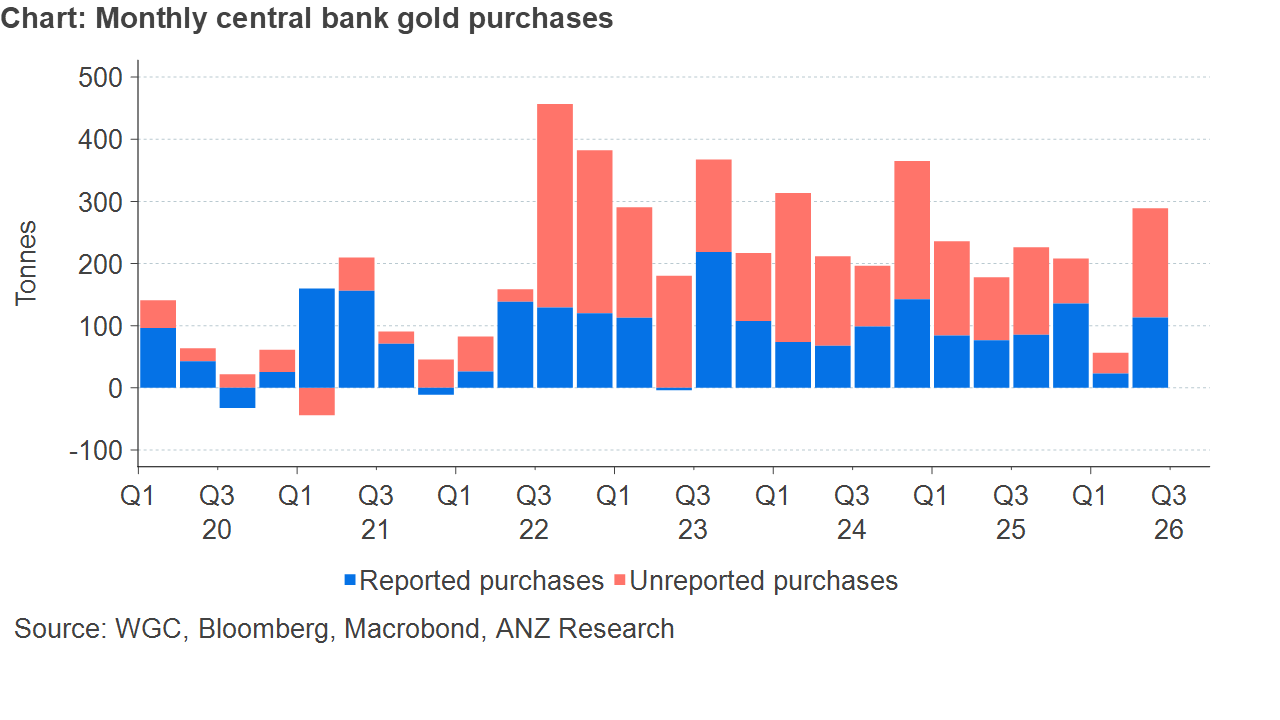
Global central banks accelerated buying in the second quarter, purchasing a record 289t, up 62% y/y. Poland’s central bank was the biggest buyer in the three-month period, accumulating 51t of gold, and the People’s Bank of China ranked second with a purchase of 33t. South Korea’s central bank also said that it would increase gold’s share of its foreign reserves, marking an end to a 13-year hiatus in purchases.
5in5 with ANZ Podcast
