
Summary
The energy sector gained, as the prospects of a US-Iran peace deal waned. Precious metals rose on a weaker USD. Weak economic data weighed on industrial metals.
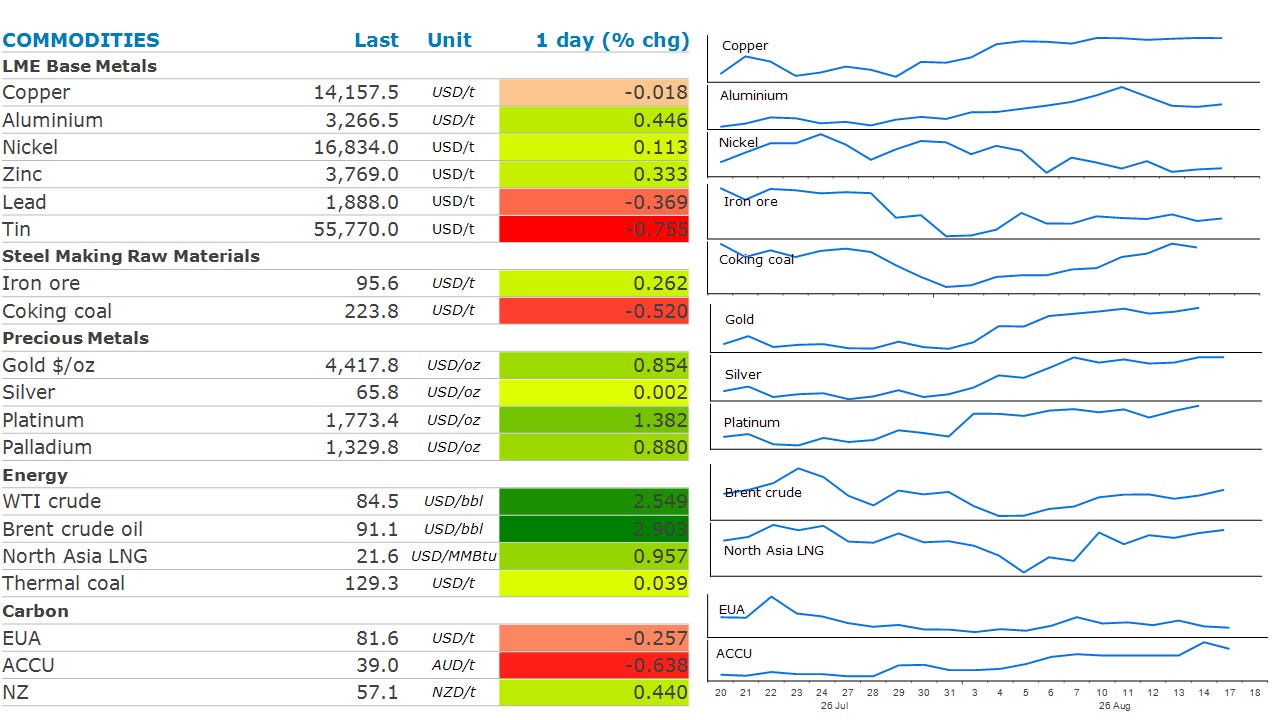
Prices and commentary accurate as of 07:00 Sydney/05:00 Singapore/17:00(-1d) New York/22:00(-1d) London.
Ahead Today
Public holidays: None.
Central bank speakers: ECB Chief Economist Philip Lane panel on monetary policy at the European Economic Association annual congress in Dublin.
Economic data: Australia: Westpac consumer confidence; Canada: housing starts; Chile: GDP; Colombia: GDP; Germany: ZEW expectations survey; Spain: trade; UK: unemployment rate, average weekly earnings; US: housing starts, industrial production (NY 09:15 / UK 14:15 / AEDT 23:15), import-export price indexes, pending home sales, ADP weekly employment change (NY 08:15 / UK 13:15 / AEDT 22:15); Uruguay: rate decision; China: second batch of trade data including alumina exports, rare-earth exports, steel product imports, aluminium product imports, oil products imports and exports, LNG imports, pipeline gas imports.
Commodities reports: API weekly US oil inventories (NY 16:30 / UK 21:30 / AEDT 06:30 Wed); LME Commitments of Traders report on metals positions; LME inventory and warrant data (~NY 04:00 / UK 09:00 / AEDT 18:00); SHFE warrant change data.
Events: Ukrainian parliament voting on new government appointments begins (to 21 Aug); Alaska, Florida and Wyoming primary elections; Bloomberg New Voices event on Martha’s Vineyard; EnerCom Denver continues; BHP earnings; Home Depot earnings; Rusal earnings; Huayou Cobalt earnings; SQM earnings.
Market data: None.
Listen to today’s 5in5 with ANZ podcast for more on the global economy and markets.
Market Commentary
Crude oil prices rose on fading hopes of a peace deal between the US and Iran. Talks appear to be at a standstill, as the 60-day truce expired on Monday. Trump said he’s not seeking to extend the memorandum of understanding signed in June and warned that he’s in no hurry to end the conflict, citing pressure from the US naval blockade on the Islamic Republic. US Energy Secretary, Chris Wright, told Fox News that the US is playing the long game with Iran, implying the administration has no imminent plans for de-escalation. Those comments came after Trump threatened to attack Oman if it gets in the way of the US blockade on Iranian ships. Oman and Iran appear to be edging closer to a deal on how the Strait of Hormuz should be managed. However, without a US involvement in those talks, it’s unlikely it will lead to the full restoration of oil flows through the key waterway.
The prospect of lingering supply disruptions lifted natural gas prices in Europe and Asia. Europe is under pressure to refill its storage facilities before the heating season. They currently sit at only 60% full, compared with the five-year seasonal norm of 78%. The prolonged disruption is also prompting some Asian nations to see more cargoes to replace Qatari volumes. Bangladesh is seeking five shipments for August and September, while Indian importers have also been active.
Weaker-than-expected economic data in China weighed on sentiment across the base metals sector. Fixed asset investment fell 6.7% y/y ytd following a disappointing H1 (-5.7%), dragged down by continued weakness in property investment (-19.2%) and infrastructure (-3.6%). Domestic consumption was weak, with retail sales growing just 0.6% y/y in July, below market expectations. One of the rare positives was industrial output technology and advanced manufacturing sectors continued to outperform, with production of industrial robots (+30.2% y/y) and new-energy vehicles (+29.9% y/y) posting strong growth. This came after signs of softening demand. Copper premiums on imports into China fell back last week in a possible sign that buyers are balking at higher prices. Earlier in the session, copper prices surged as a surge in US imports continues to tightness elsewhere. Traders remain concerned about a potential decision to impose tariffs. Spot prices traded as much as USD545/t above the 3mth futures contract, the highest level since a historic squeeze in 2021.
Iron ore prices were also under pressure following data that showed Chinese steel production tumbled last month. Steelmakers pushed out only 76.93mt in July, down 3.6% y/y. That was the weakest monthly total for 2026, according to the National Bureau of Statistics. Output over the first seven months of the year was down 3.1% y/y. However, the weak data increased the likelihood of additional stimulus. GDP grew only 4.3% y/y in Q2. The July Politburo meeting called for enhancing counter-cyclical policy adjustment.
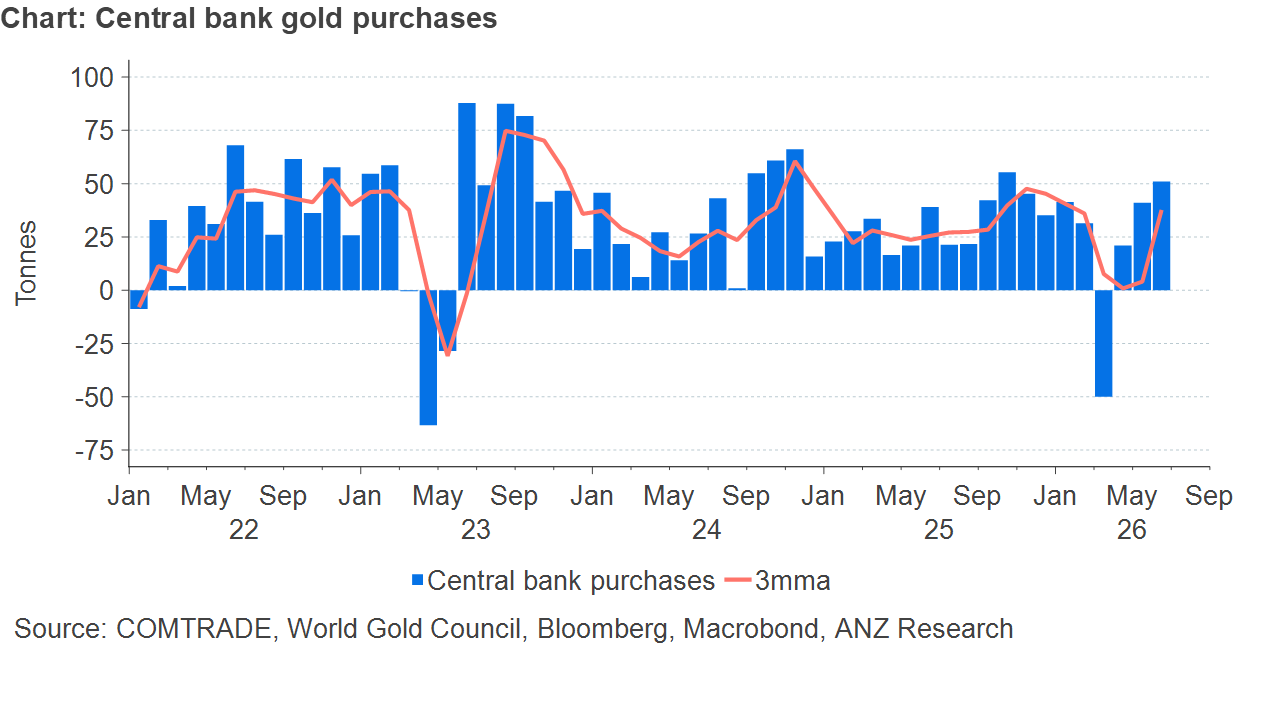
Gold extended recent gains as easing expectations of Fed rate hikes put downward pressure on the USD. A trade-weighted gauge of the USD hit its lowest level since May, making gold cheaper for many buyers. This has triggered renewed investment demand. Gold-backed ETFs recorded their first monthly inflow in July for four months. This has been aided by strong central bank buying. Second quarter purchases remained strong at 289t.
Chart of the Day
Central bank buying should keep a solid floor gold demand. Poland and China have been key buyers, adding gold on price weakness. However, the buyer base is broadening. South Korea’s central bank bought gold-linked assets for the first time since 2013. We expect future growth in official-sector demand to be driven increasingly by new buyers. Given weaker-than-expected central bank demand of 345t in H1, we have lowered our full-year forecast to 820t from 950t.
5in5 with ANZ Podcast
