Commodities Wrap: Metals gains as Fed holds back from hiking rates
Friday 31 July, 2026

Summary
The energy sector fell as supply flows picked up from the Persian Gulf. Precious metals gained after the Fed held rates steady yesterday. Industrial metals pushed higher on supply-side issues.
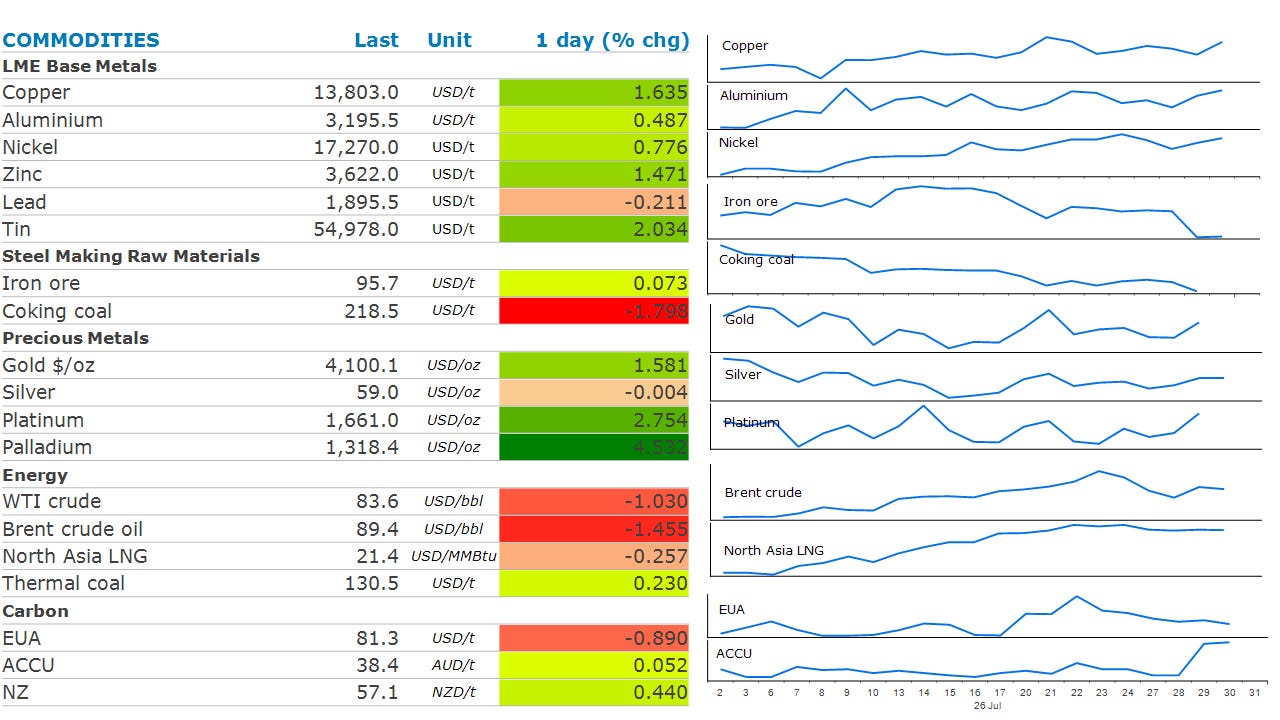
Prices and commentary accurate as of 07:00 Sydney/05:00 Singapore/17:00(-1d) New York/22:00(-1d) London.
Ahead Today
Public holidays: None
Central bank speakers: None
Economic data: China: Manufacturing PMI, non-manufacturing PMI; Colombia: unemployment, rate decision; Eurozone: CPI (11:00am Brussels / 5:00am NY / 7:00pm AEDT); France: CPI; Germany: unemployment; Hong Kong: GDP; Italy: CPI, consumer confidence; Japan: BOJ rate decision, jobless rate, Tokyo CPI, industrial production, retail sales; Macau: GDP; Poland: CPI; Serbia: GDP, industrial output; South Africa: trade balance; South Korea: industrial production; Sri Lanka: CPI; Taiwan: GDP; Thailand: current account balance; US: University of Michigan consumer sentiment, employment cost index, MNI Chicago PMI
Commodities reports: Shanghai Futures Exchange weekly commodities inventories (approximately 3:30pm local time); Baker Hughes weekly rig count (1:00pm NY / 6:00pm UK / 3:00am AEDT next day); CFTC Commitments of Traders (3:30pm NY / 8:30pm UK / 5:30am AEDT next day); ICE Futures Europe Commitments of Traders (6:30pm London / 1:30pm NY / 4:30am AEDT next day)
Events: Chevron earnings; ExxonMobil earnings; OMV 2Q earnings; Engie 2Q earnings; IAG 2Q earnings; IOC quarterly earnings; Imperial Oil 2Q earnings; Enbridge 2Q earnings; Dominion Energy 2Q earnings; BOJ policy meeting outcome
Market data: Brent September futures expiry; Romania sovereign rating review; Mauritius sovereign rating review; Croatia sovereign rating review
Listen to today’s 5in5 with ANZ podcast for more on the global economy and markets.
Market Commentary
Crude oil edged lower as rising tensions in the Middle East were offset by signs of increased flows in the Strait of Hormuz. Fourteen commodity vessels have crossed the key waterway in both directions, according to Kpler. That’s up from only single digits last week. There were also signs that the market has avoided the worst-case scenario of a complete halt to oil flowing through the Bab al-Mandeb Strait in the Red Sea following attacks by the Iranian-backed Houthi militant group on oil tankers. Traffic has only halved compared to normal levels, despite the group announcing a blockade of vessels utilising Saudi Arabian ports. This comes despite conflict between the US and Iran continuing. The Islamic Revolutionary Guard Corps said it targeted the Al-Azraq Air Base in Jordan on Thursday, destroying three F-35 aircraft. This saw the US hit dozens of Iranian military targets.
Supply disruptions outside of the Middle East were also in focus. Oil loadings were halted again at a port in the Black Sea. Two tankers with a combined capacity of 2mbbls were struck early on Thursday. This brings the number of attacks this month to nine at the Caspian Pipeline Consortium terminal that is crucial in getting 1.8mb/d from Kazakhstan to the international market. Meanwhile, Russia extended a diesel export ban until 1 September to help support its domestic market amid attacks on oil refineries by Ukraine. This continues to tighten oil product markets, with heating oil futures up sharply in recent weeks.
Concerns over supply disruptions also eased in natural gas markets in Europe and Asia. This followed reports that a liquefied natural gas cargo managed to cross the Strait of Hormuz amid the escalation of fighting in the Middle East. The shipment from Qatar is the first LNG vessel to transit the Strait of Hormuz since one of its tankers was attacked more than three weeks ago. Pakistan, a major buyer of Qatari LNG, is also said to have negotiated with Iran to secure safe passage for at least one Qatari shipment, according to a Bloomberg report. This saw North Asia LNG prices edge lower while European benchmark futures were also down. However, traders in Europe remain concerned about rebuilding inventories before the heating season. The region’s facilities are only 56% full, compared with the normal seasonal level of 72%.
Gold gained nearly 1% as traders contemplated the Fed decision to keep rates on hold. Following the meeting, yields on the shortest-term Treasuries fell (as mentioned earlier). Sentiment was also supported by a World Gold Council report that said demand remained resilient at 1,269t in Q2. The key driver was central bank purchases, which rose to 289t during the quarter.
Sentiment across the base metal sector was also boosted by the Fed leaving rates unchanged. However, signs of short-term tightness also provided some support. Spot copper prices have moved to a USD24/t premium to the three-month future, a condition known as backwardation that normally signals tightening supply. This may be due to ongoing concerns that the Trump administration may impose tariffs on copper imports. A report on the US copper market has been undertaken, with conjecture that it will recommend new measures to support the local industry. This has seen inventories in the US rise steadily over the past few months.
Chart of the Day
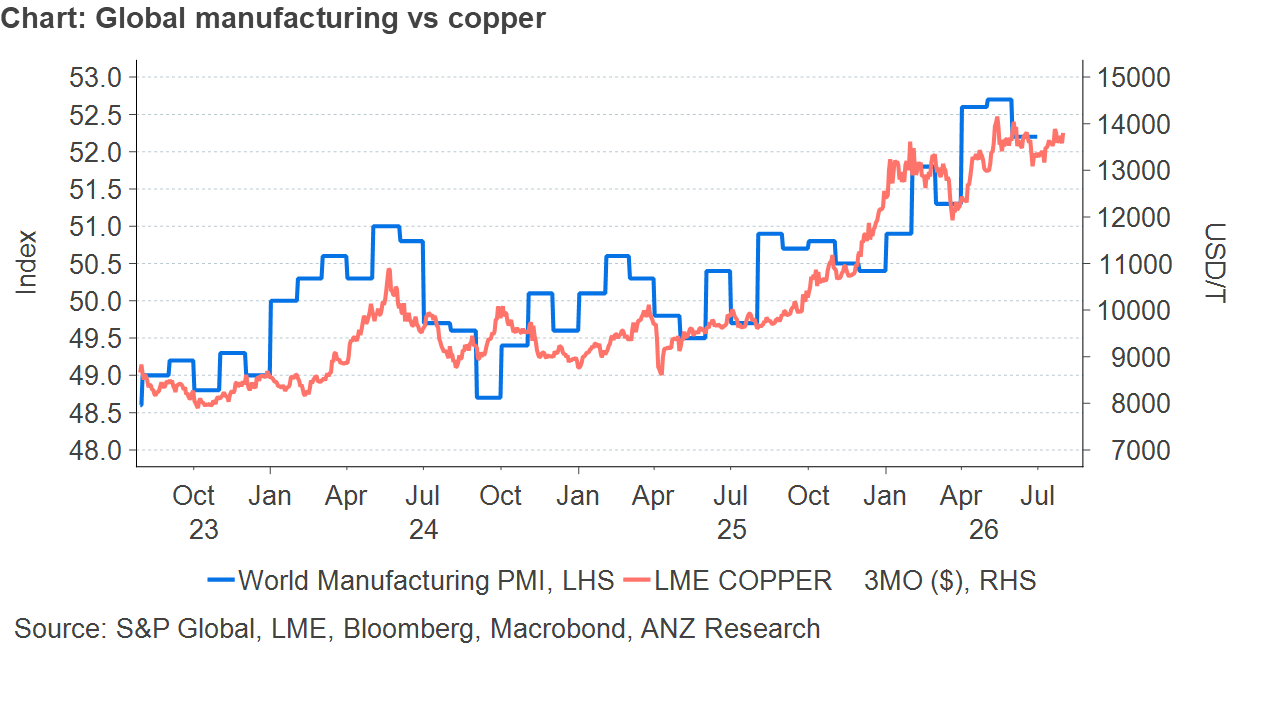
Supply side issues have been the main focus for traders in the copper market. Recent disruptions have no doubt tightened the market. However, demand has also been a factor. Global manufacturing activity has shown steady improvement over the past 18 months, with the global manufacturing PMI pushing well into expansionary territory. That should should continue to support demand for copper in the near term.
5in5 with ANZ Podcast
