
Summary
US attacks on Iran pushed the energy sector higher. Precious metals gained amid lower-than-expected inflation data. Industrial metals fell on weak economic data in China.
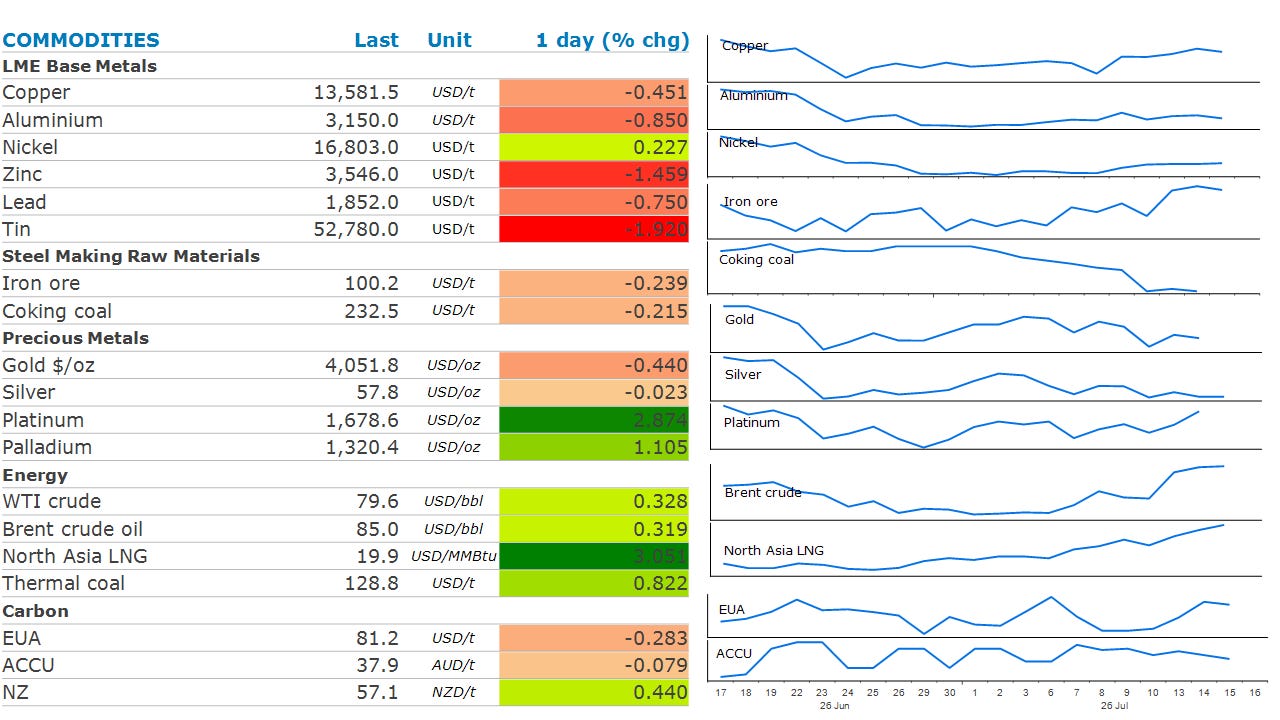
Prices and commentary accurate as of 07:00 Sydney/05:00 Singapore/17:00(-1d) New York/22:00(-1d) London.
Ahead Today
Public holidays: None reported.
Central bank speakers: Fed – Lorie Logan speaks on economy; Fed – Philip Jefferson at Stanford Institute for Economic Policy Research; Fed – Jeff Schmid at Grand Island Economic Forum; ECB enters quiet period ahead of 22–23 Jul meeting; Swiss National Bank publishes summary of 18 Jun rate decision.
Economic data: Canada – housing starts; Israel – GDP; Italy – CPI, trade; Netherlands – unemployment; South Korea – rate decision; UK – industrial production, trade balance; US – retail sales, initial jobless claims (08:30 NY / 13:30 UK / 23:30 AEDT), business inventories, pending home sales.
Commodities reports: Singapore onshore oil-product stockpiles; IEA Global Critical Minerals Outlook 2026; Angola preliminary September crude export programme; Insights Global ARA oil-product inventories; EIA weekly US natural gas inventories (10:30 NY / 15:30 UK / 01:30 AEDT 17 Jul).
Events: BHP workers’ planned eight-hour strike at Port Hedland; Open Championship begins at Royal Birkdale (through 19 Jul); WTI August options expiry.
Market data: Netflix earnings; TSMC earnings; SSE trading statement
Listen to today’s 5in5 with ANZ podcast for more on the global economy and markets.
Market Commentary
Crude oil prices pushed higher as the US continued its attacks on Iran, raising concerns of further disruptions to oil supplies. President Trump pledged to intensify the bombardment of Iran until it stops attacking ships in the Strait of Hormuz and agrees to a reopening. This could include an expansion of US military operations in Iran and the seizure of Kharg Island, which is home to Iran’s main oil export terminal, according to the Wall Street Journal. Iran has so far shown little sign it will back down. The Islamic Revolutionary Guard Corps said that the strait will remain closed until the US ends its strikes and the blockade of its ports. However, capping the upside for prices were signs of stabilisation in the recent drawdown in US inventories. Crude oil stockpiles dropped by almost 1.7mbbl last week as oil exports rose but are still below recent, pre-conflict levels. However, the US strategic petroleum reserve fell by 2,985kbbl over the past week.
Global gas markets remained on edge as the Middle East conflict continues to impact supply. North Asian LNG prices seem destined to push back above USD20/MMBtu as the earlier recovery in LNG tankers transiting the strait falters. The attack on a Qatari LNG tanker has shaken the confidence of the biggest LNG exporter in the Middle East. In Europe, benchmark natural gas prices are now at their highest since late March, with gains of about 12% since the start of the week. The continued squeeze on flows will no doubt hamper Europe’s efforts to refill storage facilities as the region competes with Asia for the limited number of LNG cargoes. Europe’s LNG imports have dropped 10% since March, with stronger renewables output in the power sector, higher pipeline flows and lower exports from Ukraine. But it has also reduced injections into gas storage. That will have to change if it is to reach its target of 90% full by the start of the heating season.
Gold edged higher following the soft inflation data earlier this week that eased concerns about an imminent rate hike by the Fed. This was supported by the weaker-than-expected US producer price data. This likely gives the Fed more room to postpone an increase in borrowing costs which has been exacerbated by the impact of the Middle East conflict on energy prices. However, the bar for the Fed to hike is high. Our base case is for the Fed to stay on hold this year, supported by fading tariff effects, a disinflationary labour market and cooling shelter inflation. The key question is whether the Fed views higher energy prices as a temporary shock or as a reason to stay cautious. Our expectation is that the Fed will continue to tolerate exogenous inflation shocks, provided they do not generate second- and third-order effects. As markets recalibrate rate-hike expectations, investment flows should gradually return to gold.
Copper ended the session lower as mixed economic data in China raised concerns about demand. China’s economy slowed more than expected last quarter to its lowest pace in more than three years. However, there were some positive signs, with industrial production in June beating market expectations. Some indicators also pointed to tightness in the physical market. Cancelled warrants, orders to withdraw metal from LME warehouses, have climbed to their highest since October 2021. Lead remained under pressure amid further inflows into LME warehouses.
Chart of the Day
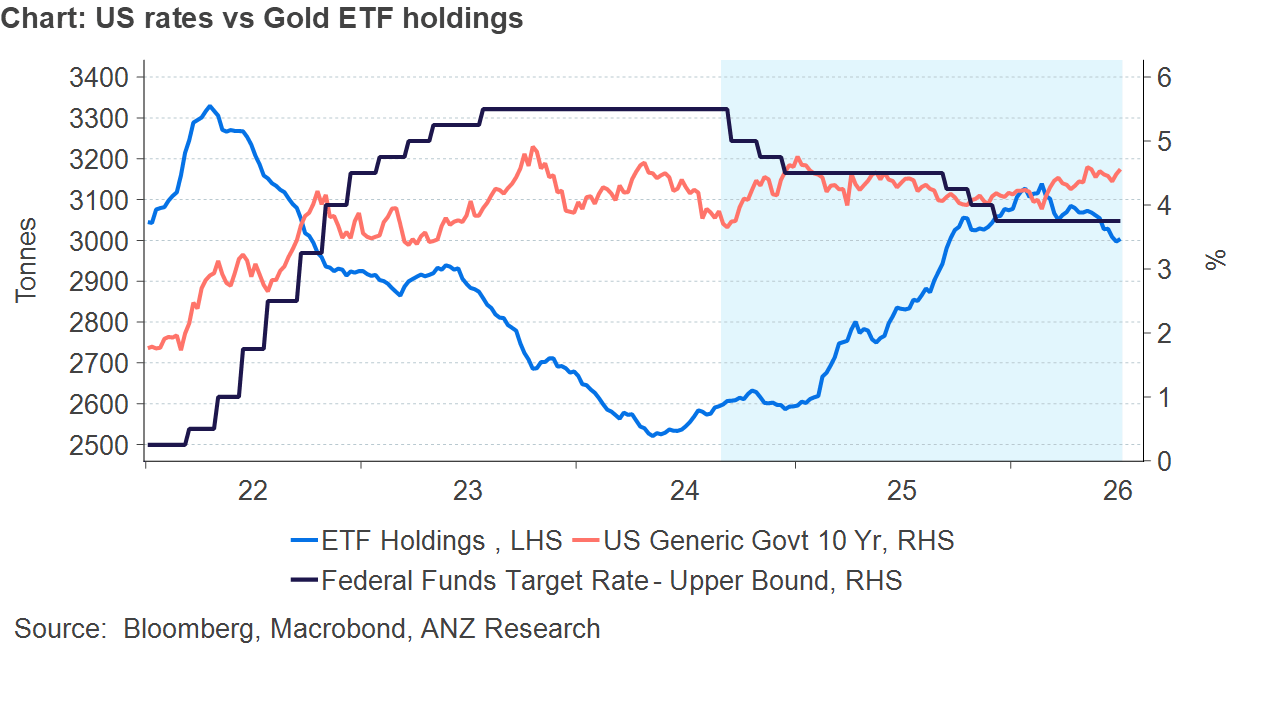
Weakness in investment demand has been the main drag on gold prices this year. Western investors (North America and Europe) typically buy gold based on returns in various asset classes. The rise of US Treasury bond yields to 4.6% means they now offer an attractive risk-free return, reducing the appeal of holding gold. This has left gold highly sensitive to shifts in rate expectations and investor positioning. Year-to-date, liquidation of exchange traded funds (ETF) stands at 78t, but the World Gold Council (WGC) reports 17t of inflows. Speculative positions, which are more tactical, have also fallen by nearly 200t in the year to date. A reversal in rate-hike expectations should support this turn and encourage investors to rotate back into gold.
5in5 with ANZ Podcast
