Commodities Wrap: Energy markets on edge amid renewed Middle East attacks
Monday 13 July, 2026

Summary
Energy gained last week on renewed hostilities in the Middle East. Industrial metal and bulks were slightly higher. Precious metals suffered on fears of rate hikes.
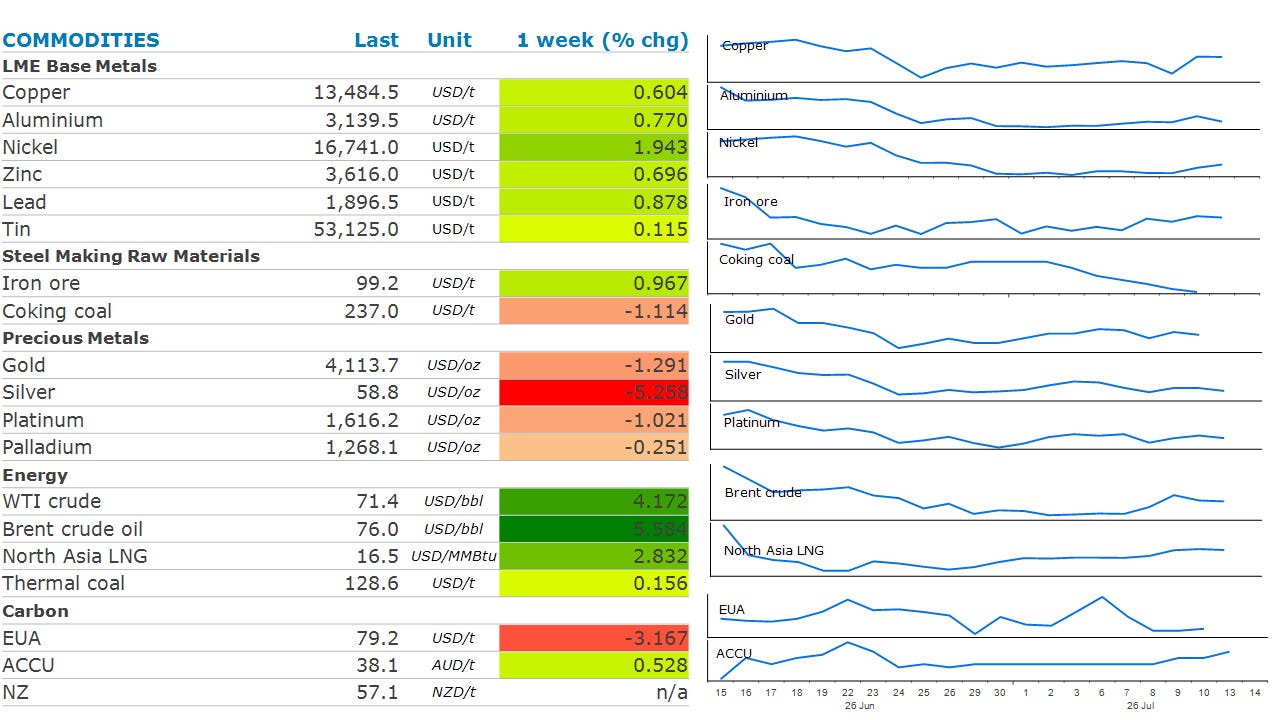
Prices and commentary accurate as of 07:00 Sydney/05:00 Singapore/17:00(-1d) New York/22:00(-1d) London.
Ahead Today
Public holidays: None reported.
Central bank speakers: ECB – Christine Lagarde meets Fed Chair Kevin Warsh (time n/s); Fed – Michelle Bowman speaks at Bank Policy Institute Roundtable, Christopher Waller speaks at NY Association for Business Economics event; ECB – Isabel Schnabel keynote and panel in Münster; BOE – Huw Pill speaks at International Finance and Banking Society conference in London.
Economic data: India – trade, CPI; Israel – trade; Russia – trade; Turkey – current account; US – federal budget balance.
Commodities reports: OPEC Monthly Oil Market Report (MOMR).
Events: OilChem LDPE conference begins in Suzhou (through 15 Jul); EU Foreign Affairs Council in Brussels discusses Ukraine and Middle East conflicts; Hong Kong Institute for Monetary and Financial Research/BIS/IMF conference on global interconnections and financial stability begins in Hong Kong (through 14 Jul); International Finance and Banking Society annual conference begins in London (through 15 Jul).
Market data: GALP 2Q trading update.
Listen to today’s 5in5 with ANZ podcast for more on the global economy and markets.
Market Commentary
Crude oil prices endured a rollercoaster ride last week as tensions flared in the Middle East. Renewed attacks between the US and Iran raised concerns that the fragile peace deal could collapse. Under the deal, there had been a ramp up of oil tankers traversing the Strait of Hormuz. The transits stopped suddenly when three ships, including a Saudi oil tanker, were struck in and around the waterway earlier in the week. The attacks spurred the US Treasury Department to revoke a waiver that allowed the sale of Iranian oil. However, prices gave back some of the gains, as both sides seemed reluctant to escalate the recent skirmishes. The US appeared to avoid targeting Iranian energy infrastructure, while Trump said he doesn’t expect a return to a full-scale conflict. Prices slumped on Friday as the two sides started technical discussions. A Qatari delegation arrived in Iran for consultations with officials, according to the semi-official Tasnim news agency. However, the International Energy Agency warned that renewed hostilities could derail efforts to rebuild depleted global oil inventories.
Hopes of a relatively quick resolution to the recent skirmishes may be in doubt after tension escalated over the weekend. The US struck Iran for a third time, eliciting retaliatory attacks on at least five Arab nations hosting US military sites. Furthermore, Iran said the Strait of Hormuz would now be closed until further notice. This is despite US Central Command denying this, saying the waterway was open to all vessels and that the military was prepared to ensure freedom of navigation. There was no visible traffic in the strait on Sunday. The maritime security threat remains severe, according to the Joint Maritime Information Centre.
European and Asian natural gas prices fell alongside lower crude oil prices on Friday on hopes that discussions between the US and Iran would stop the recent attacks from escalating. The disruptions have already caused some concern that Europe will not be able to refill its storage facilities ahead of the winter heating season. In the first eight days of July, its LNG imports fell more than 15% y/y, and were 18% lower last month, according to Kpler. However, the attack on a Qatari LNG tanker earlier in the week is still likely to have a lasting impact. Qatar, one of the world’s biggest LNG exporters, paused its efforts to rapidly revive production due to safety concerns. High temperatures in Asia are also boosting gas-fired power demand, which has already prompted several importers to tap the spot market. This is likely to increase competition for LNG in coming months.
Aluminium fell on Friday on signs of improving supply. Emirates Global Aluminium said it restarted a key alumina plant in Abu Dhabi that was attacked in the early stages of the Middle East conflict. It said it expects the facility to reach 50% capacity within days. This comes after it said it was aiming to speed up the restart of its associated smelter, which accounts for 10% of global output. Nevertheless, the metal still closed the week higher amid the renewed hostilities between the US and Iran, which could curb the transport of metal through Hormuz. Gold fell nearly 4% last week as the renewed attacks in the Middle East raised the prospect that the Fed could keep interest rates higher for longer to combat stubbornly high inflation.
Chart of the Day
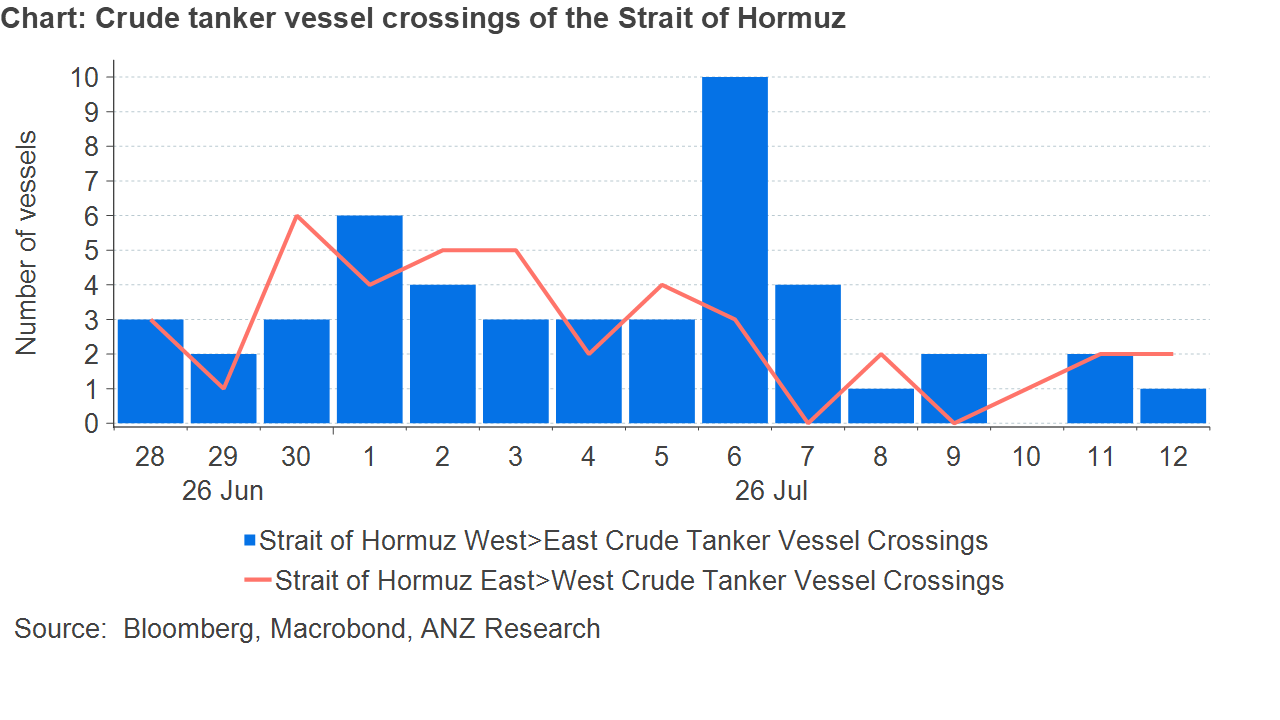
After showing promising signs earlier this month, tankers crossings of the Strait of Hormuz have dried up amid renewed attacks in the Middle East. Both inbound and outbound transits are now virtually at a standstill, with only 1 or 2 vessels making the increasingly risky journey.
5in5 with ANZ Podcast
